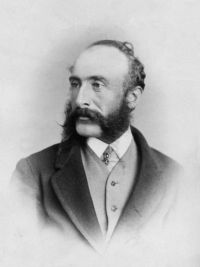
Robert Grant Haliburton

Biographical details

Portrait of Robert Grant Haliburton Robert Grant Haliburton,  Popular Science Monthly (1885)

“ The French took possession of and colonized that country early in the seventeenth century, and their writers are silent as to the existence of any Spanish settlement there at that time.
So thoroughly forgotten is this lost colony of Terra Nova that, though there are many Portuguese names that survive on the map of Northeastern America, they no longer suggest their origin or meaning. Few persons imagine that the Bay of Fundy is the "Deep Bay," or Baya Fonda; or that Cape Race means the "Bare Cape" or Cabo raso. The "Land of the Corte Reals" knows them no more.
”
Source: Wikisource

Portrait of Robert Grant Haliburton Robert Grant Haliburton,  Popular Science Monthly (1885)

“ The later Saga of his son-in-law, Karlsefne, which, like the geographical notices quoted by Rafn, was written in Iceland, was evidently based, not on information derived from people who had been in Vinland, but on an imperfect version of the Greenland Saga, for almost all the courses described by them differ 90° from those given in the Saga of Eric the Red, a uniformity of error which must have arisen from the use of a sketch-map of the voyage to Vinland, in which the points of the compass were omitted or incorrectly placed. What is north in the one is generally east in the other. ”
Source: Wikisource

Portrait of Robert Grant Haliburton Robert Grant Haliburton,  Popular Science Monthly (1885)

“ Why was Sydney—at one time known as Spanish Harbor—the favorite resort of Spanish fishermen? About the time Fagundes sailed to Cape Breton, the Spaniards seemed to question his right to that country, as appears from the Spanish map of 1527, where the Spanish line of demarkation includes Cape Breton and Nova Scotia, leaving Newfoundland to the Portuguese. ”
Source: Wikisource

Get perspective with Kwize: daily news enlightened by great literature