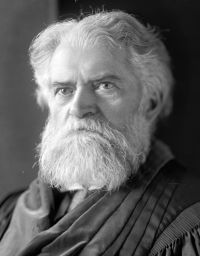
William Frederick Denning and Simon Newcomb

Biographical details

William Frederick Denning and Simon Newcomb 1911 Encyclopædia Britannica (1911)

When we institute a comparison between Jupiter and the earth on the basis that the atmosphere of the former planet bears the same relation to his mass as the atmosphere of the earth bears to her mass, we find that a state of things must prevail on Jupiter very dissimilar to that affecting our own globe. The density of the Jovian atmosphere we should expect to be fully six times as great as the density of our air at sea-level, while it would be comparatively shallow.
Source: Wikisource

William Frederick Denning and Simon Newcomb 1911 Encyclopædia Britannica (1911)

In fact it may safely be said that no planetary marking has ever aroused such widespread interest and attracted such frequent observation as the great red spot on Jupiter.
The slight inclination of the equator of this planet to the plane of his orbit suggests that he experiences few seasonal changes. From the conditions we are, in fact, led to expect a prevailing calm in his atmosphere, the more so from the circumstance that the amount of the sun’s heat poured upon each square mile of it is (on the average) less than the 27th part of that received by each square mile of the earth’s surface.
Source: Wikisource

William Frederick Denning and Simon Newcomb 1911 Encyclopædia Britannica (1911)

The absolute extinction of the satellites, even in the most powerful telescopes, while in the shadow of Jupiter, shows that they cannot receive sufficient light from their primary to render them visible, and the darkness of the shadows of the satellites when projected on the planet’s disk proves that the latter cannot be self-luminous except in an insensible degree.
Source: Wikisource

Get perspective with Kwize: daily news enlightened by great literature