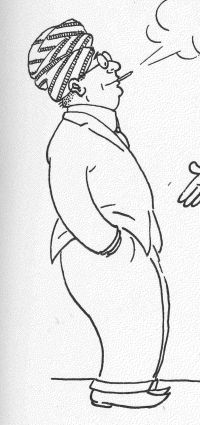
Achmed Abdullah

Achmed Abdullah

Summary

Portrait of Achmed Abdullah Achmed Abdullah Henri Always Says So! (1917)

It had been the song of a jewel; a jewel which meant to its owner everlasting youth and everlasting love. Afterwards, Si-Ali Hamouda Bey had told him that the jewel—a flawless, ten-carat emerald—really existed—“and as to the promise of everlasting youth and love,” he had added, “even to that is there a foundation of fact. For only the man blessed with the greatest strength of youth can win it; only the greatest love in the world can conquer it”
Source: Wikisource

Portrait of Achmed Abdullah Achmed Abdullah Henri Always Says So! (1917)

And so, doubtless, was Henri!
She was indeed only nineteen, but already Paris was at her feet. Amaury Delande had written plays for her; Coty had called his newest and most exotic perfume after her; the Abbé Lapraze, over at the church of Paul de Saint-Victor, had anathematized her; and Arthur Meyer had said in the Gaulois that she looked like a Watteau painted by Forain—and the Count was sixty-five, gouty, addicted to flannel underwear, and arrived at that epoch in life where one breakfasts on a bromo-seltzer, a cigarette, and no food.
Source: Wikisource

Portrait of Achmed Abdullah Achmed Abdullah Henri Always Says So! (1917)

Only this tale had the advantage of being true.
“Many men have tried,” Si-Ali Hamouda Bey had wound up, “but they died—all—they died the slow death of Africa. Perhaps,” smiling into his short-cropped mustache, “their strength of youth was not great enough—perhaps their love was not deep enough!”
Youth and strength—and love!
Thus the Count’s thoughts as he sat by the open window, smoking countless cigarettes, looking out into the Place Royale—watching the night through, until he could see the distant buildings change from indefinite outlines into black, jagged silhouettes.
Source: Wikisource

Get perspective with Kwize: daily news enlightened by great literature