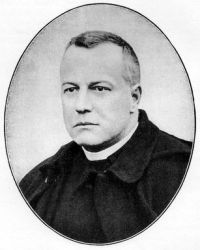
Adrian Fortescue

Adrian Fortescue

Summary

Portrait of Adrian Fortescue Adrian Fortescue,  Catholic Encyclopedia (1913)

“ The priest and deacon bring the offerings from the Prothesis to the altar while the people sing the Cherubikon. The kiss of peace follows, with the prayer belonging to it; then the Creed is said and the Offertory prayer at the altar. (In other liturgies the Offertory is said before the Great Entrance at the Prothesis.) The Anaphora begins, as always, with the greeting to the people and the dialogue: "Let us lift up our hearts." ”
Source: Wikisource

Portrait of Adrian Fortescue Adrian Fortescue,  Catholic Encyclopedia (1913)

“ III. The Coptic Liturgies.—After the Monophysite schism the Copts composed a number of liturgies in their own language. Three of these became the most inportant and are still used: those of St. Cyril, St. Gregory (of Nazianzus) , and St. Basil. They differ only in the Anaphoras which are joined to a common Preparation and Mass of the Catechumens. The Anaphora of St. Cyril, also called that of St. Mark, together with the part of the liturgy that is common to all, corresponds exactly to the Greek St. Mark. ”
Source: Wikisource

Portrait of Adrian Fortescue Adrian Fortescue,  Catholic Encyclopedia (1913)

“ Some more prayers are said in the Diakonikon, and the liturgy ends with the words: "Blessed be God who blesses, sanctifies, protects, and keeps us all through the share in His holy mysteries. He is blessed for ever. Amen."
The characteristic points of this rite are the nine Kyrie eleisons at the beginning, the Offertory prayers said at the altar instead of at the Prothesis, and especially the place of the great Supplication before the Sanctus.
”
Source: Wikisource

Get perspective with Kwize: daily news enlightened by great literature