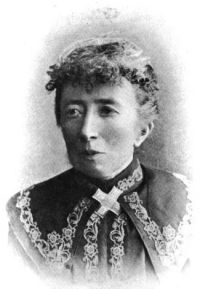
 Agnes Mary Clerke,
1911 Encyclopædia Britannica, Volume 13…
(1911)
Agnes Mary Clerke,
1911 Encyclopædia Britannica, Volume 13…
(1911)
“ Data of this kind, which are by other means inaccessible to the astronomer, are obviously indispensable to any adequate conception of the stellar system as a whole or in its parts. In solar physics Huggins suggested a spectroscopic method for viewing the red prominences in daylight; and his experiments went far towards settling a much-disputed question regarding the solar distribution of calcium. In the general solar spectrum this element is represented by a large number of lines, but in the spectrum of the prominences and chromosphere one pair only can be detected. ”
