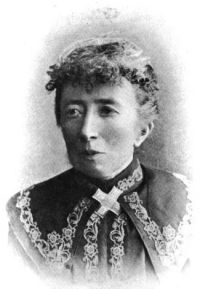
Agnes Mary Clerke

Biographical details

Portrait of Agnes Mary Clerke Agnes Mary Clerke Dictionary of National Biography… (1891)

Herschel, without the soaring genius of his father, had a wider range and a more catholic mind. He was led to astronomy by filial piety, in opposition to a spontaneous preference for chemistry and optics. ‘Light,’ he used to say, ‘was his first love.’ Yet his position as a celestial explorer is unique. He was an unsurpassed observer, and his breadth of knowledge and power of vividly describing what he saw added incalculably to the value of his observations. His books hence take high rank among the elevating influences of this century. He never lost his taste for simple amusements
Source: Wikisource

Portrait of Agnes Mary Clerke Agnes Mary Clerke 1911 Encyclopædia Britannica (1911)

A certain heaviness of style, too, and laborious picturesqueness of treatment make it more imposing than attractive to the general reader. But its supreme and abiding value consists in its faithful reflection of the mind of a great man. No higher eulogium can be passed on Alexander von Humboldt than that, in attempting, and not unworthily attempting, to portray the universe, he succeeded still more perfectly in portraying his own comprehensive intelligence.
Source: Wikisource

Portrait of Agnes Mary Clerke Agnes Mary Clerke 1911 Encyclopædia Britannica, Volume 28… (1911)

ZODIAC (ὁ ζωδιακὸς κύκλος, from ζώδιον, “a little animal”) , in astronomy and astrology, an imaginary zone of the heavens within which lie the paths of the sun, moon and principal planets. It is bounded by two circles equidistant from the ecliptic, about eighteen degrees apart; and it is divided into twelve signs, and marked by twelve constellations.
Source: Wikisource

Get perspective with Kwize: daily news enlightened by great literature