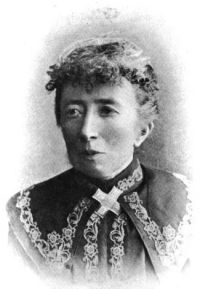
Agnes Mary Clerke

Agnes Mary Clerke

Summary

Portrait of Agnes Mary Clerke Agnes Mary Clerke Dictionary of National Biography… (1891)

Herschel, without the soaring genius of his father, had a wider range and a more catholic mind. He was led to astronomy by filial piety, in opposition to a spontaneous preference for chemistry and optics. ‘Light,’ he used to say, ‘was his first love.’ Yet his position as a celestial explorer is unique. He was an unsurpassed observer, and his breadth of knowledge and power of vividly describing what he saw added incalculably to the value of his observations. His books hence take high rank among the elevating influences of this century. He never lost his taste for simple amusements
Source: Wikisource

Portrait of Agnes Mary Clerke Agnes Mary Clerke Dictionary of National Biography… (1885)

He was at the time president of the Royal Astronomical Society.
The abilities of Francis Baily were not of the highest order. As a mathematician his range was a limited one. He never mastered the refinements of modern analysis, and was frequently indebted to the aid of Professors Airy and De Morgan in working out his investigations. Nor was his mind visited by any of the luminous inspirations of genius. Yet his life presents an almost unique example of laborious usefulness to science.
Source: Wikisource

Portrait of Agnes Mary Clerke Agnes Mary Clerke Dictionary of National Biography… (1891)

Hearne wrote in 1723 of his ‘very strange unaccountable genius,’ by which he became ‘a prodigy for his skill in astronomy, and had he lived in all probability would have proved the greatest man in the whole world in his profession’ (MS. Diary in Bodleian Library, No. 102, p. 62) . His genius was akin, and certainly not inferior, to that of Kepler. He had the same patient fervour in the pursuit of knowledge, the same instinct for generalisation, the same fidelity to truth, and without Kepler's touch of extravagance.
Source: Wikisource

Get perspective with Kwize: daily news enlightened by great literature