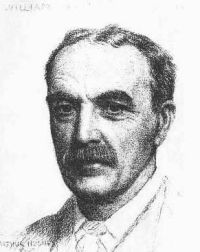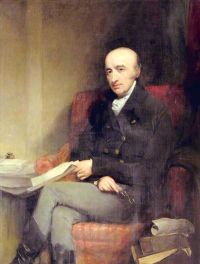
William Hyde Wollaston

Definition and stakes

Portrait of William Hyde Wollaston William Hyde Wollaston Philosophical Transactions of the Royal Society (1806)

In estimating the utmost effect which one body can produce upon another at rest, the same result is obtained by employing impetus as ascensional force, according to Huygens; for if the body A were allowed to ascend to the height due to its velocity y and if by any simple mechanical contrivance of a lever or otherwise the body B were to be raised by the descent of A, it is well known that the heights of ascent would be reciprocally as the bodies
Source: Wikisource

Portrait of William Hyde Wollaston William Hyde Wollaston Philosophical Transactions of the Royal Society (1806)

In this case, since the moving force of the spring is the same upon each of the bodies, the accelerating force acting upon B at each point is to the retarding force opposed to A at the corresponding points in the reciprocal ratio of the bodies, and the squares of the velocities produced and destroyed by its action through a given space will consequently be in that same ratio.
Source: Wikisource

Get perspective with Kwize: daily news enlightened by great literature