Gottfried Wilhelm Leibniz

Definition and stakes

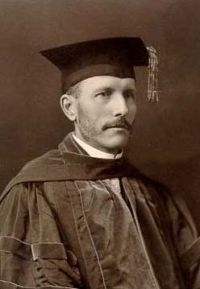
Portrait of Florian Cajori Florian Cajori,  A History of Mathematics (1893)

“ It is not true that the Binomial Theorem is also engraved on it.
We pass to Leibniz, the second and independent inventor of the calculus. Gottfried Wilhelm Leibniz (1646–1716) was born in Leipzig. No period in the history of any civilised nation could have been less favourable for literary and scientific pursuits than the middle of the seventeenth century in Germany. Yet circumstances seem to have happily combined to bestow on the youthful genius an education hardly otherwise obtainable during this darkest period of German history.
”
Source: Wikisource

W. H. Wilkins,  Caroline the Illustrious, vol. 1… (1901)

“ Leibniz, Sophie Charlotte’s chosen guide, philosopher and friend, is worthy of more than passing notice, since his influence over the Princess Caroline was second only to that of the Queen of Prussia herself. In Caroline’s youth, Gottfried Wilhelm Leibniz was a prominent figure at Berlin, whither he frequently journeyed from Hanover. He was one of the most learned men of his time, almost equally eminent as a philosopher, mathematician and man of affairs. ”
Source: Gutenberg

Freiherr von Gottfried Wilhelm Leibniz,  Theodicy

“ If one answers yes, one plunges into an insane labyrinth: for, as man's soul is an immaterial substance, one will be bound to say that the local movement of certain bodies is an efficient cause of the thoughts in a mind, a statement contrary to the most obvious notions that philosophy imparts to us. If one answers no, one will be constrained to admit that the influence of our organs upon our thoughts depends neither upon the internal qualities of matter, nor upon the laws of motion, but upon an arbitrary institution of the creator. ”
Source: Gutenberg

Get perspective with Kwize: daily news enlightened by great literature