“ Can you tell what matter really is? Before you cry Materialism, you had better find what matter is. Can you tell of anything without a material basis? Is it possible to imagine the annihilation of a single atom? Is it possible for you to conceive of the creation of a single atom? Can you have a thought that is not suggested to you by what you call matter? Did any man or woman or child ever have a solitary thought, dream or conception, that was not suggested to them by something they had seen in nature?—Ingersoll. [235] The Origin of Belief in the Soul. ”
Matter
Definition and stakes
Matter, a foundational concept in philosophy and science, refers to the physical substance that constitutes reality. Thinkers from various traditions have examined its nature: Emerson associated it with mind through analogies, while Subba Row described it as the "permanent possibility of sensations.
" Powell highlighted its function as the foundation of knowledge, and James challenged its primacy in contrast to spirit. These viewpoints illustrate matter as both a scientific basis and a philosophical symbol, connecting materiality with consciousness. The theme emphasizes its dual role as a tangible entity and a conceptual framework through which existence is understood.
Quotes about “matter”
John Wesley Powell,
Truth and Error — Chapter XIV.
(1898)
“ The word matter is the name of a collection of particles and every particle is a combination of essentials. The concept of matter has passed through the crucible of human experience and the most thorough and profound scientific investigation. All human knowledge, all scientific research, all ideation, and all logical expression are founded on this concept. To deny the reality of matter is to murder reason. ”
“ They educate both the Understanding and the Reason. Every property of matter is a school for the understanding,—its solidity or resistance, its inertia, its extension, its figure, its divisibility. The understanding adds, divides, combines, measures, and finds nutriment and room for its activity in this worthy scene. Meantime, Reason transfers all these lessons into its own world of thought, by perceiving the analogy that marries Matter and Mind. ”

Various, Popular Science Monthly (1902)
“ The sentient energy with which we began, which was at least equal in dignity with matter at the outset, and which assumed importance enough in the scheme to cause the matter to move, to attract and to repel, is now made the function of matter. Matter is the substrate, the substance; soul or mind the function of matter, housed in the latter and dependent upon it. Matter has become king; energy or mind its slave. ”
Thomas Brown, Lectures on the Philosophy of the Human Mind…
“ What we now term matter, however, I have repeatedly observed,—is that which we consider as occupying space, and resisting our effort to compress it; and those qualities of matter may well be said to be primary, by which matter itself, as thus defined, becomes known to us,—or by the union of which, in our conception, we form the complex notion of matter, and give or withhold that name according as these qualities are present or absent. Extension and resistance are the distinguishing qualities that direct us in all our applications of the word which comprehends them. ”
Lorenz Oken,
Elements of Physiophilosophy
“ The matter, which is the direct position of God, which fills the whole universe, which is the time in a state of tension and motion, the formed space, the heavy primary essence, I call the Primary matter, the matter of the world, cosmic matter, Æther. The æther is the first realization of God, the eternal position of the same. It is the first matter of creation. ”
T. Subba Row, A Collection of Esoteric Writings of T. Subba Row (1910)
“ Matter, then, is the permanent possibility of sensations; and the so-called Laws of matter are, properly speaking, the Laws which govern the succession and co-existence of our states of consciousness. ”
William James, Pragmatism: A New Name for Some Old Ways of Thinking
“ So the universe has always appeared to the natural mind as a kind of enigma, of which the key must be sought in the shape of some illuminating or power-bringing word or name. That word names the universe's PRINCIPLE, and to possess it is, after a fashion, to possess the universe itself. 'God,' 'Matter,' 'Reason,' 'the Absolute,' 'Energy,' are so many solving names. ”
William James, Pragmatism: A New Name for Some Old Ways of Thinking
“ What do we MEAN by matter? What practical difference can it make NOW that the world should be run by matter or by spirit? I think we find that the problem takes with this a rather different character. ”
Thomas Henry Huxley,
Lay Sermons, Addresses and Reviews
“ In itself it is of little moment whether we express the phænomena of matter in terms of spirit; or the phænomena of spirit, in terms of matter: matter may be regarded as a form of thought, thought may be regarded as a property of matter—each statement has a certain relative truth. But with a view to the progress of science, the materialistic terminology is in every way to be preferred. ”
Jean-Marie Guyau,
The Non-religion of the Future…
“ Back of matter, which thought takes cognizance of, and back of thought, which takes cognizance of itself, lies infinity, which envelops both of them, and which seems the most fundamental aspect of matter itself. ”
William Whewell,
History of scientific ideas
(1858)
“ We give the name of Matter, he observes, to that which has extension and resistance: these, therefore, are Primary qualities of matter, because they compose our definition of it. All other qualities are Secondary, since they are ascribed to bodies only because we find them associated with the primary qualities which form our notion of those bodies. ”
James W. Lee, The Making of a Man
“ Matter is here we know; and matter has not only form, extension, impenetrability, for its qualities, but indestructibility. Take the matter that enters into the composition of the earth. The amount of it is fixed and definite. ”
Alexander Bain,
Practical Essays
“ As it is, matter, in its commoner aspects and properties, is perfectly intelligible; in the great number and variety of its endowments or properties, it is revealed to us slowly and with much difficulty, and these subtle properties—the deep affinities and molecular arrangements—- are the mysteries rightly so called. ”
Bertrand Russell,
The Analysis of Mind
“ The stuff of which the world of our experience is composed is, in my belief, neither mind nor matter, but something more primitive than either. Both mind and matter seem to be composite, and the stuff of which they are compounded lies in a sense between the two, in a sense above them both, like a common ancestor. ”
John Stuart Mill,
A System of Logic, Ratiocinative and Inductive
“ Without entering into the grounds of the metaphysical doubts which have been raised concerning the existence of Matter and Mind as objective realities, we stated as sufficient for us the conclusion in which the best thinkers are now for the most part agreed, that all we can know of Matter is the sensations which it gives us, and the order of occurrence of those sensations; and that while the substance Body is the unknown cause of our sensations, the substance Mind is the unknown recipient. ”
Robert Hunt, The Poetry of Science; or, Studies of the Physical Phenomena of Nature
“ The dependence of all the systems of worlds upon each other, every dust composing each individual globe being “weighed in a balance,” the adjustment of the powers by which every physical condition is ordered, the disposition of matter in the mass of the earth, and the close relation of the kingdoms of nature,—are all revelations of natural truths, exalting the mind to the divine conception of the universe. ”
John Henry Pepper,
The Boy's Playbook of Science
“ Such a numerous and varied collection of bodies must necessarily have certain qualities, peculiarities, or properties; and hence we come in the first place to consider "The general powers or properties of matter." ”
Samuel Johnson,
The History of Rasselas, Prince of Abyssinia
(1759)
“ Yet, if any part of matter be devoid of thought, what part can we suppose to think? Matter can differ from matter only in form, density, bulk, motion, and direction of motion: to which of these, however varied or combined, can consciousness be annexed? ”
John Bernhard Stallo, Popular Science Monthly (1874)
“ In this view the solid form of matter is not only the basis and origin of all its further determinations—of all its evolutions and changes—but it is also the primary and typical element of its mental representation and conception. ”
Charles Bradlaugh,
A Plea for Atheism
(1870s)
“ The material universe—that is, matter, either began to be, or it never began to be. That it never began to be, is evident in this, that if it began to be, it must have had a cause; for whatever begins to be must have a cause. And the cause of matter, must be of matter; for what is not of matter, cannot make matter begin to be. ”
Alexander Philip,
Essays Towards a Theory of Knowledge
“ The theory, as announced by the leading men of science, has therefore been to the effect that there exist in the physical universe two real things—Matter and Energy—in place of one only, as commonly supposed for so long. ”
Henry White Warren,
Recreations in Astronomy
“ What we call matter may be best understood as God's force, will, knowledge, rendered apparent, static, and unweariably operative. Unless matter is eternal, which is unthinkable, there was nothing out of which the world could be made, but God himself; and, reverently be it said, matter seems to retain fit capabilities for such source. ”
Charles Southwell, Superstition Unveiled
“ Now, an existence, properly so called, must have at least two attributes, and whatever exhibits two or more attributes is matter. The two attributes necessary to existence are solidity and extension. Take from matter these attributes and matter itself vanishes. ”
George Ticknor Curtis, Creation or Evolution? A Philosophical Inquiry
“ As the power of the physical senses to obtain for us a knowledge of the properties of matter is limited, even when our senses are in the utmost state of their normal capacity, there may be properties of matter which will never become known to us in our present existence. ”
Bertrand Russell,
Mysticism and Logic and Other Essays
(1917)
“ We defined the "physical thing" as the class of its appearances, but this can hardly be taken as a definition of matter. We want to be able to express the fact that the appearance of a thing in a given perspective is causally affected by the matter between the thing and the perspective. We have found a meaning for "between a thing and a perspective." But we want matter to be something other than the whole class of appearances of a thing, in order to state the influence of matter on appearances. ”
Mary Baker G. Eddy,
Science and Health with Key to the Scriptures
(1889)
“ The first-named theory, that matter is everything, is quite as reasonable as the second, that Mind and matter co-exist and co-operate. One only of the following statements can be true: (1) that everything is matter; (2) that everything is Mind. ”
Herbert Spencer,
First Principles
“ The fact, however, which it most concerns us here to observe, is, the nature of the perceptions by which the permanence of Matter is perpetually illustrated to us, and from which Science draws the inference that Matter is indestructible. These perceptions, under all their forms, amount simply to this—that the force which a given quantity of matter exercises, 244remains always the same. ”
Robert Hunt, The Poetry of Science; or, Studies of the Physical Phenomena of Nature
“ Matter, or that whatever it be of which all the objects in nature which manifest themselves directly to our senses consist, presents us with two general qualities, which at first sight appear to stand in contradiction to each other—activity and inertness. Its activity is proved by its power of spontaneously setting other matter in motion, and of itself obeying their mutual impulse, and moving under the influence of its own and other force ”
Francis E. Nipher, Popular Science Monthly (1909)
“ What do we then know of the phenomenon that one conscious being, embodied in a mass of matter, may determine or influence the thoughts and actions of another conscious being, by formulating thoughts in words, and delivering them to him through the air? ”
Charles Francis Stocking, Carmen Ariza
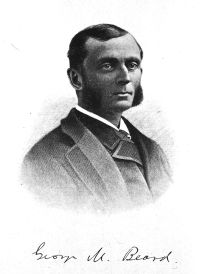
“ The constitution of matter, speaking now from an admittedly materialistic standpoint, that of the physical sciences, is a subject of vastest interest and importance to mankind, for human existence is material. ”
George Miller Beard,
Popular Science Monthly
(1878)
“ Under this class of claims, that from the limitations of the human brain can neither be proved nor disproved, are the conventional definitions of matter, and accepted distinctions between matter and mind, or other forms of force. The qualities that for ages have been attributed to matter, as inertia and extension, apply correctly enough to that limited portion and form of matter that the senses can appreciate; but, as has been shown, all but an infinitesimal portion of Nature is permanently sealed against the senses. ”
baron d' Paul Henri Thiry Holbach, The System of Nature, or, the Laws of the Moral and Physical World…
“ Thus, relatively to us, matter is all that affects our senses in any manner whatever; the various properties we attribute to matter, by which we discriminate its diversity, are founded on the different impressions we receive on the changes they produce in us. ”
Duchess of Margaret Cavendish Newcastle, Philosophical Letters: or, modest Reflections upon some Opinions in Natural Philosophy
“ But this is to be observed, That the rational matter can and doth move in its own substance, as being the purest and subtillest degree of matter; but the sensitive being not so pure and subtil, moves always with the inanimate Matter, and so the perceptive figures which the rational Matter, or rational corporeal Motions make, are made in their own degree of Matter ”
Charles Henry Brent,
The Sixth Sense: Its Cultivation and Use
“ To call it an element seems to clothe it in a vagueness which its character does not merit. If man were merely a phase of matter, we could employ the term element with propriety. That which can be only an element in a universe, at any rate may be a faculty or sense in man. ”
David Hume,
A Treatise of Human Nature
“ If we take in our hand any volume of divinity or school-metaphysics, for instance, let us ask, Does it contain any abstract reasoning for quantity or number? No. Does it contain any experimental reasoning concerning matter of fact and existence? No. Commit it then to the flames, for it can contain nothing but sophistry and illusion.’—‘Inquiry concerning the Human Understanding,’ at the end. ”
Carveth Read, Logic: Deductive and Inductive
“ These are called the Primary Qualities of Matter; and it is assumed that they belong to matter by itself, whether we look on or not: whilst colour, heat, sound, etc., are called Secondary Qualities, as depending entirely upon the reaction of some conscious animal. By physical science the world is considered in the abstract, as a perpetual redistribution of matter and energy, and the distracting multiplicity of sensations seems to be got rid of. ”
Myra Reynolds,
The Learned Lady in England, 1650-1760
“ But first we should define matter, which, you know, the logicians tell us is an extended solid substance. Out of this matter some is made into rose and peach-trees; the next form which matter takes is animal life ”
William Whewell,
History of scientific ideas
(1858)
“ Like the one just considered, they form part of our fundamental conception of matter; they are not the results of any experience, but are the hypotheses to which we are irresistibly led, when we would liberate our reasonings concerning force and matter from a dependence on the special results of experience. ”
James Frederick Ferrier,
Blackwood's Magazine
(1842)
“ Let us try it by the test of experience, by hypothetically answering the original question, in the first place, in the affirmative, and by saying that, although we conceive ourselves and all percipient beings annihilated, still the great universe of matter would maintain its place as firmly and as faithfully as before. ”
Richard Watson,
A Biblical and Theological Dictionary
“ If all matter be cogitative, then it must be so quatenus [so far forth as] matter, and thinking must be of the essence and definition of it; whereas by matter no more is meant than a substance extended and impenetrable to other matter. ”
William Whewell,
Astronomy and General Physics Considered with Reference to Natural Theology
“ We can easily suppose that in this way there may be the most profound and admirable reasons for the existence of the present universal properties of matter, which we cannot apprehend in consequence of the limited nature of our knowledge, and of our faculties. ”
Camille Flammarion,
Astronomy for Amateurs
“ And yet, let us dwell on it, since this reality is the most evident demonstration of the ideal; since what [Pg 335] exists is you, is all of us, is Life; and matter is only its substance, like the materials of a house, and even less so, since its particles only pass rapidly through the framework of our bodies. ”
James Frederick Ferrier,
Philosophical Works of the Late James Frederick Ferrier
(1875)
“ But matter is not necessarily coextensive with the particular and changeable element, because much may be conceived—if not actually by us, yet possibly by other intellects—besides matter, of which intelligence may be cognisant. ”
Richard Watson,
A Biblical and Theological Dictionary
“ Beside all which, since magnitude, figure, and motion are but accidents of matter, not matter, and only the substance is truly matter; and since the substance of any one part of matter does not differ from that of another, if any matter can be by nature cogitative, all must be so: but this we have seen cannot be. ”
James Frederick Ferrier,
Blackwood's Magazine
(1838)
“ The universe, commences the metaphysician, [1] is divided into two distinct orders of existence, mind and matter. Matter is known by its changes alone, mind also is known only by its changes. Thus, continues he, for all scientific purposes, the analogy between the two is complete, and science in both cases is practicable only by noting these changes and the order in which they recur. ”
Related terms
Authors who wrote about “matter”

Related articles
From Filth to Fertility, The Dual Legacy of Organic Waste
Humanity has long grappled with the paradox of organic waste: a source of both revulsion and vitality. From ancient taboos to modern agriculture, understanding its dual nature is crucial for public health and environmental sustainability.
The chemical doppelgänger: Why finding life on Mars is a philosophical problem
The difficulty of proving past life on Mars stems from the 'vital force' debate. Geological forces constantly create structures that imitate biological activity, demanding a rigorous philosophical and chemical approach to distinguish coordinated living behavior from random abiotic complexity.