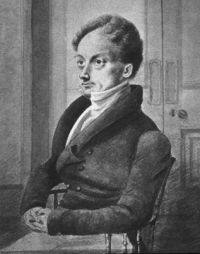
Thomas Brown

Biographical details

Thomas Brown,  Lectures on the Philosophy of the Human Mind… (1822)

“ Is man, whose frail generations begin and pass away, but one of the links of an infinite chain of beings like himself, uncaused, and co-eternal with that self-existing world of which he is the feeble tenant? or, Is he the offspring of an all creating Power, that adapted him to nature, and nature to him, formed together with the magnificent scene of things around him, to enjoy its blessings, and to adore, with the gratitude of happiness, the wisdom and goodness from which they flow? What attributes, of a Being so transcendent, may human reason presume to explore? ”
Source: Wikisource

Thomas Brown,  Lectures on the Philosophy of the Human Mind…

“ You see well, that this is to die almost the moment one is born. Our existence is a point—our duration an instant—our globe an atom. Scarcely have we begun to pick up a little knowledge, when death rushes in upon us, before we can have acquired any thing like experience. As for me, I cannot venture even to think of any project. I feel myself but like a drop of water in the ocean; and, especially now, when I look to you and to myself, I really feel quite ashamed of the ridiculous appearance which I make in the universe. ”
Source: Gutenberg

Thomas Brown,  The works of Mr. Thomas Brown, serious and comical… (1730)

“ There would be no sorrow, no fear, no desire, no despair, no jealousy, no hatred, if there were no love. The soul becomes a restless sea whose tumultuous waves are continually foaming, every sense is an inlet to this violent passion: and there are but few objects which can affect the soul, that do not give it birth: as heat produces some things and destroys others, so love, not unlike it, is the origin of good and evil. It may be call’d the school of honour and virtue; and yet not improperly a theatre of horror and confusion too.
’Tis the powerful and pleasing band of human society
”
Source: Gutenberg

Get perspective with Kwize: daily news enlightened by great literature