“ Make a whirlwind of the idea. This crowd may be rendered sublime. Let us learn how to make use of that vast conflagration of principles and virtues, which sparkles, bursts forth and quivers at certain hours. These bare feet, these bare arms, these rags, these ignorances, these abjectnesses, these darknesses, may be employed in the conquest of the ideal. Gaze past the people, and you will perceive truth. ”
Idea
Definition and stakes
An idea, derived from the Greek ἰδέα (form or pattern), is a mental construct or conceptual representation central to philosophy and human cognition. From Plato’s eternal forms to Locke’s empirically grounded mental impressions, thinkers have grappled with its nature.
Victor Hugo envisioned ideas as sparks for sublime action, while Josiah Royce emphasized their self-directed purpose. Bertrand Russell explored their generalization, and Hegel linked them to artistic idealism. These perspectives reveal ideas as bridges between subjective thought and objective reality, shaping both individual meaning and collective progress.
Quotes about “idea”
 Josiah Royce,
The World and the Individual, First Series
(1899)
Josiah Royce,
The World and the Individual, First Series
(1899)
“ We shall, perhaps to our surprise, reach the seemingly paradoxical and essentially idealistic thesis that no being in heaven or in earth, or in the waters under the earth, has power to give to an idea any purpose unless, the idea itself, as idea, as a fragment of life, as a conscious thrill, so to speak, of inner meaning, first somehow truly learns so to develope its internal meaning as to assign to itself just that specific purpose. ”
Ethel D. Puffer, Psychology of Beauty
“ In this sense, when we say, "What a wonderful idea!" we really mean, what a wonderful fitness of form to idea,-- which is the same as saying, what a wonderful form, or more technically, what a wonderful unity. ”
Josiah Royce,
The World and the Individual, First Series
(1899)
“ The idea, I have said, seeks its own. It can be judged by nothing but what it intends. Whether I think of God or of yesterday’s events, of my own death, or of the destiny of mankind, of mathematical truth, or of physical facts, of affairs of business, or of Being itself, it is first of all what I mean, and not what somebody merely external to myself might desire me to mean, that both gives me an object, and determines for me the standard of correspondence to the object whereby I must be judged. ”
Josiah Royce,
The World and the Individual, First Series
(1899)
“ By thus first distinguishing sharply between the conscious internal meaning of an idea and its apparently external meaning, we get before us an important way of stating the problem of knowledge or, in other words, the problem of the whole relation between Idea and Being. ”
 Bertrand Russell,
The Analysis of Mind — Lecture XI: General Ideas and Thought
(1921)
Bertrand Russell,
The Analysis of Mind — Lecture XI: General Ideas and Thought
(1921)
“ Now, if we will annex a meaning to our words, and speak only of what we can conceive, I believe we shall acknowledge that an idea which, considered in itself, is particular, becomes general by being made to represent or stand for all other particular ideas of the same sort. ”
Josiah Royce,
The World and the Individual, First Series
(1899)
“ I have defined in general the problem of the relation of the World as Idea to the World as Fact, and have stated our issue as precisely this relation between Ideas and Reality. In order to assist in clarifying our undertaking, I have also given a general definition of what an idea is, and have stated the logical contrast between the consciously internal and the apparently external meaning of any finite idea. ”
 Georg Wilhelm Friedrich Hegel,
The Philosophy of Fine Art, volume 1…
Georg Wilhelm Friedrich Hegel,
The Philosophy of Fine Art, volume 1…
“ For the Idea as Ideal, by which we mean as clothed in a form within the grasp of sensuous imagination and perception, and in its activity as action and accomplishment, is, if we define it strictly, just this self-relation of the subjective individuality. ”
 Johann Gottlieb Fichte,
Characteristics of the Present Age
(1806)
Johann Gottlieb Fichte,
Characteristics of the Present Age
(1806)
“ Should he say,—‘All this devotion of Life to the realization of an Idea is a mere chimera to which we ourselves have given birth;’—then we have proved to him historically, that at all times there have been men who have led this Life in the Idea, and that all things great and good which now exist in the world, are the products of this Life. ”
 Matthew Arnold,
Culture and Anarchy
Matthew Arnold,
Culture and Anarchy
“ Perhaps we may help ourselves to see this clearer by an illustration drawn from the treatment of a single great idea which has profoundly engaged the human spirit, and has given it eminent opportunities for showing its nobleness and energy. ”
 Redmond Barry,
Inaugural address, delivered before the members of the Victorian Institute…
(1854 | noyear)
Redmond Barry,
Inaugural address, delivered before the members of the Victorian Institute…
(1854 | noyear)
“ In the elaboration of each separate idea, a compensating mutual relation with some other cognate idea is found, which brings a fresh agency to bear upon, assimilate or clash with it; such attrition, different from that which wastes and diminishes physical bodies, serving to sharpen and refine the mind, correct, enlarge or perfect the idea. ”
Josiah Royce,
The World and the Individual, First Series
(1899)
“ In other words, we shall find that while, for our purposes, we, the critics, must first sharply distinguish the apparently external purpose that, as it were, from without, we assign to the idea, from the internal meaning of the idea, as present to a passing conscious instant, still, this our assignment of the external purpose, this our assertion that the idea knows or resembles, or imitates, or corresponds to, fact wholly beyond itself, must in the end be justified, if at all, by appeal to the truth, i.e. ”
 Mikhail Bakunin,
God and the State — Chapter 2
Mikhail Bakunin,
God and the State — Chapter 2
“ The general idea is always an abstraction and, for that very reason, in some sort a negation of real life. ”
 Herbert Spencer,
First Principles
Herbert Spencer,
First Principles
“ Whether the wish is father to the thought, or whether sentiment and idea have a common genesis, there equally arises the question—Whence comes the sentiment? That it is a constituent in man’s nature is implied by the hypothesis ”
 Walter Pater,
The Renaissance: Studies in Art and Poetry
Walter Pater,
The Renaissance: Studies in Art and Poetry
“ The theory or idea or system which requires of us the sacrifice of any part of this experience, in consideration of some interest into which we cannot enter, or some abstract theory we have not identified with ourselves, or what is only conventional, has no real claim upon us. ”
Josiah Royce,
The World and the Individual, First Series
(1899)
“ So now we have defined what we mean by an idea, and what we mean by the internal meaning of an idea. But ideas often seem to have a meaning, yes, as one must add, finite ideas always undertake or appear to have a meaning, that is not exhausted by this conscious internal meaning presented and relatively fulfilled at the moment when the idea is there for our finite view. ”
 Rufus M. Jones,
Spiritual Reformers in the 16th & 17th Centuries
Rufus M. Jones,
Spiritual Reformers in the 16th & 17th Centuries
“ The seventh, and final, "quality" is body or figure, by which he means the fundamental tendency or energy toward expression in actuality and concrete form. The final goal of intelligent purpose is the realization of wisdom, of idea, in actual Nature-forms and life-forms—the incarnation of the spirit. ”
A Course in Miracles: Workbook for Students…
“ It seems as if the world determines what you perceive. Today's idea introduces the concept that your thoughts determine the world you see. Be glad indeed to practice the idea in its initial form, for in this idea is your release made sure. ”
Francis Lynde, A private chivalry (1900)
“ A touch of idealism, of nobility of thought and purpose, mingled with an air of reality and well-chosen expression, are the most notable features of a book that has not the ordinary defects of such qualities. ”
 Charles Dudley Warner,
Some Causes of the Prevailing Discontent
Charles Dudley Warner,
Some Causes of the Prevailing Discontent
“ The world is ruled by ideas, by abstract thought. Society, literature, art, politics, in any given age are what the prevailing system of philosophy makes them. We recognize this clearly in studying any past period. ”
The Forerunner, Volume 1 (1909-1910…
“ Minds develop. New knowledge comes. People's ideas and feelings change—some people's. These new ideas and feelings seek expression ion the natural forms—speech and literature, as is legitimate and right. ”
 Marcel Proust,
Within a Budding Grove
Marcel Proust,
Within a Budding Grove
“ A powerful idea communicates some of its strength to him who challenges it. ”
 John Taylor,
Journal of Discourses — Volume 7…
John Taylor,
Journal of Discourses — Volume 7…
“ Something that will be of some real practical use is, in my opinion, what we want; but to talk about abstract theories, idealities, and things that have not much substance or reality in them, I do not think is of much use to anybody. ”
Josiah Royce,
The World and the Individual, First Series
(1899)
“ Our very theory insists that your internal meanings, your ideas viewed as internally significant, your selections and expressions, are typical instances of facts, and of precisely the facts of whose unity the world consists. ”
 Joseph McCabe,
The Psychology of Religion
(1927)
Joseph McCabe,
The Psychology of Religion
(1927)
“ An idea or institution may arise for one reason and be maintained for quite a different reason. ”
The German Classics of the Nineteenth and Twentieth Centuries…
“ You strive to simplify your great world of ideas; I seek variety for my small means. You have to govern a whole realm, I but a somewhat numerous family of ideas, which I would be heartily glad to be able to extend into a little world.Your mind works intuitively to an extraordinary degree, and all your thinking powers appear, as it were, to have come to an agreement with your imagination to be their common representative. ”
William James, Pragmatism: A New Name for Some Old Ways of Thinking
“ They lead us, namely, through the acts and other ideas which they instigate, into or up to, or towards, other parts of experience with which we feel all the while-such feeling being among our potentialities--that the original ideas remain in agreement. ”
Boyd Henry Bode, Creative Intelligence: Essays in the Pragmatic Attitude
“ The biography of philosophy, hence, reveals it to have the same possibilities and the same fate that all other ideas have. Today ideas are the patent of our humanity, the stuff and form of intelligence, the differentiæ between us and the beasts. ”
G. H. Mair, English Literature: Modern
“ In the treatment of thought and feeling they wanted clearness, they wanted ideas which the mass of men would readily apprehend and assent to, and they wanted not hints or half-spoken suggestions but complete statement. ”
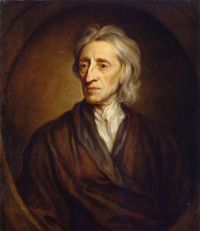 John Locke,
An Essay Concerning Human Understanding
(1689)
John Locke,
An Essay Concerning Human Understanding
(1689)
“ Let the ideas of being and matter be strongly joined, either by education or much thought; whilst these are still combined in the mind, what notions, what reasonings, will there be about separate spirits? ”
Josiah Royce,
The Conception of God
(1897)
“ This generalised form of attention, which we attribute to the Absolute Experience, is now conceived by us as that aspect of this Absolute which, in the total movement of the world’s unity, determines the ideas to find this concrete realisation which they do find. ”
Boyd Henry Bode, Creative Intelligence: Essays in the Pragmatic Attitude
“ Ideas, then, bear three types of relations to organic life, relations socially incarnated in traditional art, religion, and philosophy. First of all they may be an expression of innate capacities, the very essence of the freedom of life. ”
 William O. Douglas,
Pierson v. Ray — Dissent
(1967)
William O. Douglas,
Pierson v. Ray — Dissent
(1967)
“ This view conceives the mind to be directed toward individual things, rather than toward general ideas, toward distinct situations of fact rather than toward some significance in human affairs that these situations may share. ”
Mihai Nadin, The Civilization of Illiteracy
“ Ideas, no matter how complex, pertain to states of affairs in the world: physical, biological, or spatial reality embodied in an individual's self-constitution. They also pertain to the states of mind of those expressing them. ”
“ As the moral ideas realize themselves in ménage and habits, so the ideals will seek to find expression in a literature, and the passive drifting together will pass over into a phase of more or less conscious and intentional organization. ”
 James Hutchins Baker,
Education and life
(1900)
James Hutchins Baker,
Education and life
(1900)
“ The reverence for nature, for its symbolism, the sanctions of religion, the transcendental belief, the poetic insight have somewhat fallen away, and the world is partly barren because not yet rehabilitated. Ideals are regarded as fit for schoolgirl essays, for weakly sentimentality, for dreamers, for those who do not understand the meaning of the new science and the new civilization. Ideals! The transcendent importance of ideals is just appearing. ”
Josiah Royce,
The World and the Individual, First Series
(1899)
“ This negative character of the universal judgments holds true of them, as we have said, just in so far as you sunder the external and the internal meanings, and just in so far as you view the Real as the Beyond, and as merely the Beyond. If you turn your attention once more to the realm of the ideas viewed as internal meanings, you see, indeed, that they are constantly becoming enriched, in their inner life, by all this process. ”
Josiah Royce,
The World and the Individual, First Series
(1899)
“ Now in this extremely elementary consideration, namely, in the consideration that unless ideas first voluntarily bind themselves to a given task, and so, by their internal purpose, already commit themselves to a certain selection of its object, they are neither true nor false, — in this consideration, I say, there may be hidden consequences that we shall later find momentous for the whole theory of Being and of truth. ”
 Victor Hugo,
William Shakespeare
Victor Hugo,
William Shakespeare
“ The human mind—an important thing to say at this minute—has a greater need of the ideal even than of the real.It is by the real that we exist; it is by the ideal that we live. ”
 Morton Prince,
The unconscious
(1921)
Morton Prince,
The unconscious
(1921)
“ It is obvious that in everyday life when by arguments, persuasion, suggestion, punishment, exhortation, or prayer we change the viewpoint of a person, we do so by building up complexes which shall act as settings and give new meanings to his ideas. I 369may add, if we wish to sway him to carry this new viewpoint to fulfilment through action we introduce into the complex an emotion which by the driving force of its impulses shall carry the ideas to practical fruition. ”
Josiah Royce,
The World and the Individual, First Series
(1899)
“ Experience and Thought are upon our hands; and together they determine for us the problems regarding Being. Realism offered to us the first solution of this problem by attempting to define the Reality of the world as something wholly independent of our ideas. ”
Georg Wilhelm Friedrich Hegel,
Hegel's Lectures on the History of Philosophy…
“ The mind makes them from ideas which it has got by sensation and reflection.” The work of the mind now consists in bringing forth from several simple so-called ideas a number of new ones, by means of its working upon this material through comparing, distinguishing and contrasting it, and finally through separation or abstraction, whereby the universal conceptions, such as space, time, existence, unity and diversity, capacity, cause and effect, freedom, necessity, take their rise. ”
 Joseph Conrad,
Under Western Eyes
(1911)
Joseph Conrad,
Under Western Eyes
(1911)
“ “The whole world is inconceivable to the strict logic of ideas. And yet the world exists to our senses, and we exist in it. There must be a necessity superior to our conceptions. ”
William James, Psychology: Briefer Course
“ Problems.—But in the theoretic as well as in the practical life there are interests of a more acute sort, taking the form of definite images of some achievement which we desire to effect. The train of ideas arising under the influence of such an interest constitutes usually the thought of the means by which the end shall be attained. ”
Josiah Royce,
The World and the Individual, First Series
(1899)
“ And now, finally, after surveying all these so various types of beings, we have to recall the comment often already made in these lectures, and to assert that not only these different kinds of realities, but also the concrete experiences whereby we come to observe, and the ideas whereby we ourselves define, describe, and in general undertake to know these very objects, are themselves also in their own measure real, and are as truly real as are the various finite objects of common sense that we know. ”
Victor Hugo,
Les Misérables
(1862)
“ Progress is the goal, the ideal is the type. What is this ideal? It is God. Ideal, absolute, perfection, infinity: identical words. ”

“ If we examine the history of ideas we shall find that they at first exist “in the air.” They float about, beautiful alluring visions, ready to be caught and made to serve mortal needs by the right man at p. ”
 David Hume,
Treatise of Human Nature/Book 1…
(1739)
David Hume,
Treatise of Human Nature/Book 1…
(1739)
“ And as the impressions of reflexion, viz. passions, desires, and emotions, which principally deserve our attention, arise mostly from ideas, ‘twill be necessary to reverse that method, which at first sight seems most natural; and in order to explain the nature and principles of the human mind, give a particular account of ideas, before we proceed to impressions. ”
Related terms
Authors who wrote about “idea”

Related articles
The Unseen Engine, The Sculpting Hand: Genius and Craft in Artistic Creation
The romantic notion of genius obscures the relentless labor of craft. True artistic creation demands a dynamic integration of both—the spark of inspiration and the disciplined hand—to transform ephemeral vision into enduring form.
Ralph Waldo Emerson, Johann Wolfgang von Goethe, Robert Louis Stevenson
The mafia as a philosophical concept: The paradox of freedom and lawlessness in sicily
The Sicilian intolerance of restraint, often called La Mafia, is not a structured criminal society but a pervasive philosophical sentiment: the desire for radical individual autonomism. This deep-seated resistance to external law, born from foreign conquest, creates a profound paradox where the quest for absolute freedom results in social terror and ungovernability.
Rex Beach, Josef Donat, F. Marion Crawford
The confrontation between natural chaos and the human dream of order
Catastrophic natural events expose the psychological and political fragility of human systems. From scientific causality to legal frameworks, humanity's quest for predictability is a constant, defining struggle against the vast unknown, navigating the narrow path between anarchy and tyranny.
Henry Adams, David Hume, Barack Obama
The Secular religion of inevitable progress: From enlightenment gospel to technological apocalypse
The idea of scientific advancement has morphed from a possibility into a deterministic, quasi-religious creed promising technological transcendence and an earthly utopia. This faith sanctions immense risk-taking by elites, but the dualism of modern power necessitates moral insight to avert an ingenious apocalypse.
Harry Emerson Fosdick, Adam Smith, Herbert Spencer
Mind over matter: The paradox of perfect control in voice culture and animal training
Mastery in any field, from training a dog to perfecting the singing voice, requires moving beyond mechanical, conscious effort toward cultivating a guiding mental purpose. The ultimate pedagogy lies in the clarity of the mind, not the force of the hand.
David C. Taylor, Charles Wesley Emerson, Paramahansa Yogananda
The synthesis of instinct and toil: locating genius in nature and art
The classic debate between instinctual drive and conscious labor defines all creation. From the architect-bee's geometric perfection to the human artist's arduous struggle, genius is revealed as the disciplined manifestation of an innate, specialized impulse.
Jean-Henri Fabre, Th. Ribot, Sir Joshua Reynolds
The burden of complexity: when literary difficulty obscures the soul
The literary representation of consciousness must navigate the inherent complexity of the soul without sacrificing clarity. Philosophical, mystical, and psychoanalytic models define the tension between profound psychological insight derived from suffering and the risk of aesthetic alienation through stylistic obscurity.
John Cowper Powys, Wilhelm Stekel, Henri Bergson
