 Lewis Carroll,
Alice in Wonderland
Lewis Carroll,
Alice in Wonderland
“ When I use a word, it means just what I choose it to mean—neither more nor less. ”
The concept of "means" refers to the methods or actions used to attain a particular objective, forming the basis of instrumentalism and instrumental value. Authors such as Lewis Carroll examined its arbitrary nature, while Oliver Wendell Holmes emphasized how small premises can result in major conclusions. F.H.
Bradley viewed actions as instruments for achieving desired outcomes, in contrast to Ralph Waldo Emerson’s perspective, which regarded character as a force independent of instrumental considerations. Philosophical and literary works highlight its dual function as both a practical tool and a moral concern, illustrating the tension between utilitarianism and ethical absolutism.
Lewis Carroll,
Alice in Wonderland
“ When I use a word, it means just what I choose it to mean—neither more nor less. ”
Oliver Wendell Holmes, The Autocrat of the Breakfast-Table
“ You see, my friends, what immense conclusions, touching our lives, our fortunes, and our sacred honor, may be reached by means of very insignificant premises. This is eminently true of manners and forms of speech; a movement or a phrase often tells you all you want to know about a person. ”
 F. H. Bradley,
Ethical Studies — Essay VII.
(1876)
F. H. Bradley,
Ethical Studies — Essay VII.
(1876)
“ The pleasant feeling which is to result from an act may be presented in imagination, and thought of as the end to be reached; or the thought of myself to be pleased as much as possible generally, and here by such means and in such a way, may be the end which I take as the principle and motive of my action. ”
 Ralph Waldo Emerson,
Essays: Second Series — Character
(1844)
Ralph Waldo Emerson,
Essays: Second Series — Character
(1844)
“ This is that which we call Character, — a reserved force which acts directly by presence, and without means. It is conceived of as a certain undemonstrable force, a Familiar or Genius, by whose impulses the man is guided, but whose counsels he cannot impart; ”
Alexander Campbell Fraser, Thomas Reid
“ Advance in philosophy is advance in interpreting the meaning of each of these three postulates, and of their mutual relations, as seen in an improved conception of what ‘matter’ means, what ‘self’ means, and what ‘God’ means. ”
 Robert Rainy,
The Expositor's Bible: The Epistle to the Philippians
Robert Rainy,
The Expositor's Bible: The Epistle to the Philippians
“ The Spirit of God may do this without means, but often He uses means, and, indeed, what we esteem little means; by little things carrying home great impressions, as out of the mouths of babes and sucklings He perfects praise. ”
 Charles Dickens,
Little Dorrit
(1857)
Charles Dickens,
Little Dorrit
(1857)
“ ‘As to being a reference,’ said Pancks, ‘you know, in a general way, what being a reference means. ”
 John Wesley,
The Means of Grace
John Wesley,
The Means of Grace
“ Here we are in the plainest manner directed to ask, in order to, or as a means of, receiving; to seek, in order to find, the grace of God, the pearl of great price; and to knock, to continue asking and seeking, if we would enter into his kingdom. 2. That no doubt might remain, our Lord labours this point in a more peculiar manner. He appeals to every man’s own heart: “What man is there of you, who, if his son ask bread, will give him a stone? ”
“ Dependence. State of being dependent (of hanging [relying] on others for support) . 7. Impotence. State of being impotent (of having no power; weak; feeble) . 8. Omnipotence. State of being all powerful. 9. Reticence. State or quality of being silent; refraining from speech.10. Sequence. State of being sequent (following) ; order of following. [68] ance, as a suffix to nouns like the following, means state of being. 1. Concordance. State of being heart with heart; harmony; agreement. 2. Consonance. State of agreement of sound with sound; tones in unison. ”
 Charlotte Brontë,
Jane Eyre
(16 October 1847)
Charlotte Brontë,
Jane Eyre
(16 October 1847)
“ Well, propensities and principles must be reconciled by some means.” ”
G. H. Armstrong, English Grammar and Composition for Public Schools
“ Tell how shall and will. are used in the following sentences:— LESSON XLVII. THE FORMS OF THE VERBS DO AND BE.DO.INDICATIVE MODE. SUBJUNCTIVE MODE. The present and past tenses of do are used as auxiliaries with the present infinitive, (1) to express emphasis; as, I do study every evening. (2) To express a denial; as, I did not do it. (3) To ask questions; as, Did you see him?When do means to perform, it is an independent verb; as, He did his part. ”
 Henry Van Dyke,
What Peace Means
Henry Van Dyke,
What Peace Means
“ Peace means something more than the mere absence of hostilities. It means justice, honour, fair-play, order, security, and the well-protected right of every man and nation to life, liberty, and the pursuit of happiness. It was the German contempt for these Christian ideals, it was the German idolatry of the pagan Odin, naked, cruel, bloody, god of war, it was the German will to power and dream of world-dominion, that made the world unsafe for real peace in 1914. ”
John Wesley,
The Means of Grace
“ We know, likewise, that he is able to give the same grace, though there were no means on the face of the earth. In this sense, we may affirm, that, with regard to God, there is no such thing as means; seeing he is equally able to work whatsoever pleaseth him, by any, or by none at all. 4. We allow farther, that the use of all means whatever will never atone for one sin; that it is the blood of Christ alone, whereby any sinner can be reconciled to God; there being no other propitiation for our sins, no other fountain for sin and uncleanness. ”
Henry Van Dyke,
What Peace Means
“ Is there no escape from Death, the Tyrant, the autocrat, the destroyer, the last enemy? Why love, why look upward, why strive for better things if this imperator of failure, ultimate extinction, rules the universe? No hope beyond the grave means no peace this side of it. ”
John Wesley,
The Means of Grace
“ As to the manner of using them, whereon indeed it wholly depends whether they should convey any grace at all to the user; it behoves us, First, always to retain a lively sense, that God is above all means. Have a care, therefore, of limiting the Almighty. He doeth whatsoever and whensoever it pleaseth him. He can convey his grace, either in or out of any of the means which he hath appointed. Perhaps he will. “Who hath known the mind of the Lord? or who hath been his counsellor?” Look then every moment for his appearing! Be it at the hour you are employed in his ordinances ”
John Wesley,
The Means of Grace
“ Others, clearly perceiving that these means did not convey the grace of God to those children of the devil, began, from this particular case, to draw a general conclusion, — that they were not means of conveying the grace of God. 4. Yet the number of those who abused the ordinances of God, was far greater than of those who despised them, till certain men arose, not only of great understanding, (sometimes joined with considerable learning,) but who likewise appeared to be men of love, experimentally acquainted with true, inward religion. ”
John Wesley,
The Means of Grace
“ What is seeking salvation by works? In the writings of St. Paul, it means, either seeking to be saved by observing the ritual works of the Mosaic law; or expecting salvation for the sake of our own works, by the merit of our own righteousness. But how is either of these implied in my waiting in the way God has ordained, and expecting that he will meet me there, because he has promised so to do? ”
John Wesley,
The Means of Grace
“ With regard to the former, we may observe, there is a kind of order, wherein God himself is generally pleased to use these means in bringing a sinner to salvation. A stupid, senseless wretch is going on in his own way, not having God in all his thoughts, when God comes upon him unawares, perhaps by an awakening sermon or conversation, perhaps by some awful providence, or, it may be, an immediate stroke of his convincing Spirit, without any outward means at all. ”
John Wesley,
The Means of Grace
“ To one who begins to feel the weight of his sins, not only hearing the Word of God, but reading it too, and perhaps other serious books, may be a means of deeper conviction. May you not advise him also, to meditate on what he reads, that it may have its full force upon his heart? ”
John Wesley,
The Means of Grace
“ We allow, though it is a melancholy truth, that a large proportion of those who are called Christians, do to this day abuse the means of grace to the destruction of their souls. This is doubtless the case with all those who rest content in the form of godliness, without the power. ”
John Wesley,
The Means of Grace
“ It is not surprising at all, if they should not always have expressed themselves with sufficient caution; so that unwary hearers might believe they condemned all outward means, as altogether unprofitable, and as not designed of God to be the ordinary channels of conveying his grace into the souls of men. ”
John Wesley,
The Means of Grace
“ Every believer in Christ is deeply convinced that there is no merit but in Him; that there is no merit in any of his own works; not in uttering the prayer, or searching the Scripture, or hearing the word of God, or eating of that bread and drinking of that cup. So that if no more be intended by the expression some have used, “Christ is the only means of grace,” than this, — that He is the only meritorious cause of it, it cannot be gainsayed by any who know the grace of God. ”
John Wesley,
The Means of Grace
“ If he finds a preacher who speaks to the heart, he is amazed, and begins searching the Scriptures, whether these things are so? The more he hears and reads, the more convinced he is; and the more he meditates thereon day and night. Perhaps he finds some other book which explains and enforces what he has heard and read in Scripture. And by all these means, the arrows of conviction sink deeper into his! ”
 P. G. Wodehouse,
A Man of Means
P. G. Wodehouse,
A Man of Means
“ Your idea of happiness is to be married to your cousin Gerry, whose only visible means of support, so far as I can gather, is the four hundred a year which he draws as a member for a constituency which has every intention of throwing him out at the next election. ”
John Wesley,
The Means of Grace
“ It is He alone who, by his own almighty power, worketh in us what is pleasing in his sight; and all outward things, unless He work in them and by them, are mere weak and beggarly elements. Whosoever, therefore, imagines there is any intrinsic power in any means whatsoever, does greatly err, not knowing the Scriptures, neither the power of God. We know that there is no inherent power in the words that are spoken in prayer, in the letter of Scripture read, the sound thereof heard, or the bread and wine received in the Lord’s Supper ”
William Mathews, Words; Their Use and Abuse
“ In every relation of life, at every moment [3] of our active being, in every thing we think or do, it is on the meaning and inflection of a word that the direction of our thoughts, and the expression of our will, turn. The soundness of our reasonings, the clearness of our belief and of our judgment, the influence we exert upon others, and the manner in which we are impressed by our fellow-men,—all depend upon a knowledge of the value of words. ”
William James, The Principles of Psychology, Volume 1…
“ Again, when we use a common noun, such as man, in a universal sense, as signifying all possible men, we are fully aware of this intention on our part, and distinguish it carefully from our intention when we mean a certain group of men, or a solitary individual before us. In the chapter on Conception we shall see how important this difference of intention is. It casts its influence over the whole of the sentence, both before and after the spot in which the word man is used. ”
Matthew Henry, Matthew Henry's Commentary on the Whole Bible… (1700s)
“ If thou canst, answer me. If thou hast so much strength and spirit left thee, and art not quite spent with the distemper and the dispute, set thy words in order, and they shall have their due consideration." Those that can speak reason will hear reason. ”
 Josiah Royce,
The World and the Individual, First Series
(1899)
Josiah Royce,
The World and the Individual, First Series
(1899)
“ Is it not indeed plain that, as we ourselves have often heretofore said, when we talk of Being, we are indeed seeking for what, if present, would satisfy or tend to satisfy our conscious needs and meanings? Let us take this very character as the sole basis of our definition of what it is to be. Let us first say that whenever we talk of Being we mean a definitely Possible Fact of experience, viewed just as something possible for us. ”
 Alfred de Musset,
The Confession of a Child of the Century…
Alfred de Musset,
The Confession of a Child of the Century…
“ Invoke the aid of reason, of habit, of the senses, the head, the heart, and explain it if you can. You will find nothing but two bodies, one here, the other there, and between them, what? Air, space, immensity. O blind fools! who fondly imagine yourselves men, and who reason of love! ”
Max Farrand, The Records of the Federal Convention of 1787 (1911)
“ To a mind naturally strong and capacious, enriched by much reading and the experience of many years, he added a manner of communicating his thoughts peculiarly his own—in which simplicity, beauty, and strength were equally conspicuous. ”
 Orison Swett Marden,
Pushing to the Front
Orison Swett Marden,
Pushing to the Front
“ CHAPTER XXVIII DECISION Resolve, and thou art free.—LONGFELLOW. The heaviest charged words in our language are those briefest ones, "yes" and "no." One stands for the surrender of the will, the other for denial; one stands for gratification, the other for character. ”
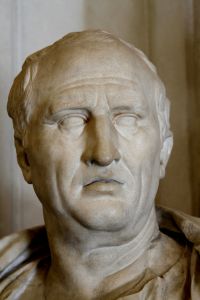 Marcus Tullius Cicero,
The Orations of Marcus Tullius Cicero…
Marcus Tullius Cicero,
The Orations of Marcus Tullius Cicero…
“ But when we speak of a man's habitual condition, we mean his constant and absolute completeness of mind or body, in some particular point—as for instance, his perception of virtue, or of some art, or else some science or other. ”
 Willard Van Orman Quine,
On What There Is
Willard Van Orman Quine,
On What There Is
“ The useful ways in which people ordinarily talk or seem to talk about meanings boil down to two: the having of meanings, which is significance, and sameness of meaning, or synonymy. What is called giving the meaning of an utterance is simply the uttering of a synonym, couched, ordinarily, in clearer language than the original. ”
James Gray, Ancient Proverbs and Maxims From Burmese Sources…
“ As applied to books, it is a general term for a treatise which includes maxims, pithy sayings, and didactic stories, intended as a guide to such matters of everyday life as form the character of an individual and influence him in his relations to his fellow-men. ”
 Samuel Taylor Coleridge,
Biographia Literaria
Samuel Taylor Coleridge,
Biographia Literaria
“ When two distinct meanings are confounded under one or more words,— (and such must be the case, as sure as our knowledge is progressive and of course imperfect) —erroneous consequences will be drawn, and what is true in one sense of the word will be affirmed as true in toto. ”
 George Edward Moore,
Principia Ethica — Chapter VI
(1903)
George Edward Moore,
Principia Ethica — Chapter VI
(1903)
“ Connected with the distinction just made between ‘object’ in the sense of the qualities actually before the mind and ‘object’ in the sense of the whole thing which possesses the qualities actually before the mind, is another distinction of the utmost importance for a correct analysis of the constituents necessary to a valuable whole. ”
 Leslie Stephen,
Social Rights And Duties: Addresses to Ethical Societies…
Leslie Stephen,
Social Rights And Duties: Addresses to Ethical Societies…
“ But above and beyond all the separate instances, such a person,—the object only to a few, perhaps, of love and reverence, but to those few the object of those feelings in the most unreserved and unequivocal form,—is something far more than a source of any number of particular benefits. ”
 Bertrand Russell,
The Analysis of Mind — Lecture X: Words and Meaning
(1921)
Bertrand Russell,
The Analysis of Mind — Lecture X: Words and Meaning
(1921)
“ When we are clear both as to what a word is in its physical aspect, and as to what sort of thing it can mean, we are in a better position to discover the relation of the two which is meaning.The things that words mean differ more than words do. ”
 Georg Wilhelm Friedrich Hegel,
The Logic of Hegel
Georg Wilhelm Friedrich Hegel,
The Logic of Hegel
“ And the unutterable,—feeling or sensation,—far from being the highest truth, is the most unimportant and untrue. If I say 'The individual,' 'This individual,' 'here,' 'now,' all these are universal terms. Everything and anything is an individual, a 'this,' and if it be sensible, is here and now. ”
 John Stuart Mill,
A System of Logic, Ratiocinative and Inductive
(1881)
John Stuart Mill,
A System of Logic, Ratiocinative and Inductive
(1881)
“ And these causes of names are the same with the causes of our conceptions, namely, some power of action, or affection, of the thing conceived, which some call the manner by which any thing works upon our senses, but by most men they are called accidents. ”
 Annie Besant,
Death—and After?
Annie Besant,
Death—and After?
“ A clear definition of terms, and a rigid adherence to them when once adopted, will at least enable us all to understand each other, and that is the first step to any fruitful comparison of experiences. ”
Chautauqua Institution, The Chautauquan, Vol. 05, May 1885…
“ Well, is it possible that any word I have here written may set some of you thinking—that’s it, set you, a fixed purpose rather than a floating one—about a definite object in life toward which, henceforth, you may bend a steady, earnest gaze? ”
 James Hudson Taylor,
Union and Communion; or, Thoughts on the Song of Solomon
James Hudson Taylor,
Union and Communion; or, Thoughts on the Song of Solomon
“ For how many have said in bewilderment at the richness of language and profusion of figure which both conceal and reveal its meaning, "How can I understand except some man should guide me?" It is safe to say that these pages cannot fail to help and bless all such. ”
 Hannah More,
Essays on Various Subjects, Principally Designed for Young Ladies
Hannah More,
Essays on Various Subjects, Principally Designed for Young Ladies
“ Yet the term good sense, is used indiscriminately to express either a finished taste for letters, or an invariable prudence in the affairs of life. It is sometimes applied to the most moderate abilities, in which case, the expression is certainly too strong; and at others to the most shining, when it is as much too weak and inadequate. ”
 Auguste Forel,
The sexual question
Auguste Forel,
The sexual question
“ Good dispositions in the domains of will, sentiment, judgment, imagination, perseverance, duty, accuracy, self-control, the faculty of thinking logically and distinguishing the true from the false, the faculty of combining æsthetic thoughts and sensations, all constitute human values which are much superior to the faculty of rapid assimilation or receptivity, and a good memory for words and phrases. ”
Canada views US military investment in its critical minerals as a threat to national identity, echoing centuries-old fears of territorial absorption. The conflict over resource extraction reveals the nation's perpetual dilemma: leveraging natural wealth without sacrificing political independence.
The creation of sublime beauty often relies on the artist's conversion of deep personal misery into external expression, an act characterized by thinkers from Hegel to Nietzsche as a transformative, agonizing process that hides the struggle from the delighted audience.
Torture is a systematic instrument of state governance, which critics have shown to be unreliable for truth-finding, corrosive to society, and often a catalyst for the very revolution it aims to suppress. The only antidote is collective action and exposure.
The 1922 Mandate tasked Great Britain with establishing a Jewish national home while safeguarding Arab rights—a formula for perpetual conflict. This inherent paradox led to political paralysis, failure of public security, and the eventual recognition by British officials that their mission was "almost insuperable," sealing the fate of the territory.
The deep decline in student engagement and achievement is a rational response to an institutional design that prioritizes social sorting and bureaucratic control over spiritual and intellectual liberation. Examining the core conflict between education as management and education as freedom.
Mass starvation results from political decisions: avarice, economic manipulation, and using food denial as a strategic weapon of war. By framing hunger as a natural calamity, human institutions evade accountability for profound, preventable systemic inequality.
The institutional logic governing 19th-century workhouses and lunatic asylums—centralized confinement, rigid routine, and task labor driven by cost-efficiency—is mirrored today in large-scale housing solutions for transient populations. This recurrent pattern inevitably clashes with human needs.
The wild goose's instinctual skein offers a model of seamless collective action, contrasting sharply with the constrained utility of its domestic counterpart. This duality illuminates the struggles of organized labor to achieve genuine interdependence amidst societal conflicts over autonomy and control.
