Electrochemistry

Definition and stakes

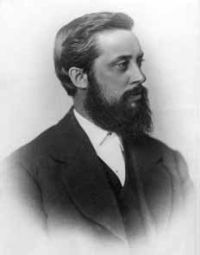
Portrait of William Arnold Anthony William Arnold Anthony,  Elementary Text-book of Physics (1897)

“ Those bodies which exhibit electrolysis are always such as have considerable freedom of motion among their molecules. Ordinarily, they are liquids or solids in solution or fused. The discharge through gases is also probably accompanied by electrolysis. Bodies which can be decomposed were called by Faraday, to whom the nomenclature of this subject is due, electrolytes. The current is usually introduced into the electrolyte by solid terminals called electrodes. The one at the higher potential is called the positive electrode or anode; the other, the negative electrode, or cathode. ”
Source: Wikisource

Various,  Popular Science Monthly (1902)

“ It seems tolerably clear from all the facts of electrolysis that electricity can only pass through a conducting liquid or electrolyte by being carried on atoms or groups of atoms which are called ions—i. e., wanderers. The quantity thus carried by a hydrogen atom or other monad element, such as sodium, silver or potassium, is a definite natural unit of electricity. The quantity carried by any other atom or group of atoms acting as an ion is always an exact integer multiple of this natural unit. ”
Source: Wikisource

William Cecil Dampier Whetham,  1911 Encyclopædia Britannica, Volume 6… (1911)

“ A cation, i.e. an ion giving up its charge at the cathode, as the electrode at which the current leaves the solution is called, carries a positive charge of electricity; an anion, travelling in the opposite direction, carries a negative charge. It will now be seen that the quantity of electricity flowing per second, i.e. the current through the solution, depends on (1) the number of the ions concerned, (2) the charge on each ion, and (3) the velocity with which the ions travel past each other. ”
Source: Wikisource

Get perspective with Kwize: daily news enlightened by great literature