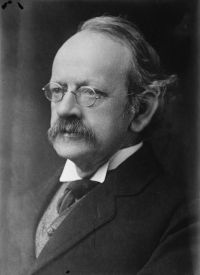
Joseph John Thomson

Biographical details

Portrait of Joseph John Thomson Joseph John Thomson 1911 Encyclopædia Britannica, Volume 6… (1911)

Thus any process which a single particle is able to effect by virtue of its energy will be done just as well a thousand miles away from the source of light as at the source itself, though of course in a given space there will not be nearly so many particles to do this process far from the source as there are close in. Thus, if one of the particles when it struck against a piece of metal caused the ejection of a corpuscle with a given velocity, the velocity of emission would not depend on the intensity of the light.
Source: Wikisource

Portrait of Joseph John Thomson Joseph John Thomson Rays of Positive Electricity and Their Application to Chemical Analyses… (1913)

If we regard the forces which keep the atoms together as electrical in their origin, the question naturally arises, are the two atoms in a molecule of hydrogen, for example, charged one with positive the other with negative electricity; or in a molecule of hydrochloric acid gas is the hydrogen atom positively charged, the chlorine negatively, or in a compound like ammonia NH3 does the nitrogen atom carry three negative charges and each of the hydrogen atoms one positive one ?
Source: Wikisource

Portrait of Joseph John Thomson Joseph John Thomson Cathode Rays (1897)

The brightest spots on the glass are by no means always the terminations of the brightest streaks of luminosity in the gas; in fact, in some cases a very bright spot on the glass is not connected with the cathode by any appreciable luminosity, though there may be plenty of luminosity in other parts of the gas. One very interesting point brought out by the photographs is that in a given magnetic field, and with a given mean potential-difference between the terminals, the path of the rays is independent of the nature of the gas.
Source: Wikisource

Get perspective with Kwize: daily news enlightened by great literature