Summary

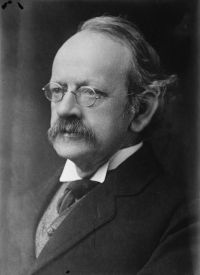
Portrait of Joseph John Thomson Joseph John Thomson Rays of Positive Electricity and Their Application to Chemical Analyses… (1913)

The fact that sparking with oxygen destroys the X3, makes the removal of the hydrogen, which is by far the largest constituent of the mixture, a matter of considerable difificulty. The most effective way I know of increasing the proportion of X3 is first to remove the oxygen, then to put the mixture of H2 and X3 into a vessel to which a palladium tube is attached; when the palladium is heated to redness the hydrogen diffuses through it much more rapidly than the X3, though some of this gas can get through the palladium.
Source: Wikisource

Portrait of Joseph John Thomson Joseph John Thomson Rays of Positive Electricity and Their Application to Chemical Analyses… (1913)

In the absence of oxygen and copper oxide X3 may be heated to a high temperature without destruction. Summing up the results we see that when hydrogen is present in the substance bombarded a continuous supply of X3 can be obtained, while from substances which do not contain hydrogen the supply is soon exhausted. Again, under certain conditions such as exposure to bright light, vigorous sparking in the presence of oxygen, contact with glowing copper oxide, X3 combines with oxygen.
Source: Wikisource

Portrait of Joseph John Thomson Joseph John Thomson Rays of Positive Electricity and Their Application to Chemical Analyses… (1913)

If there were a line corresponding to the carbon atom with three charges, the ordinary carbon line would be prolonged until its distance from the vertical was only one-third of the normal distance, while a carbon atom with four charges would prolong the ordinary carbon line to within one-quarter of the distance from the axis.
Source: Wikisource

Get perspective with Kwize: daily news enlightened by great literature