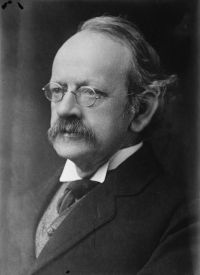
 Joseph John Thomson,
Rays of Positive Electricity and Their Application to Chemical Analyses…
(1913)
Joseph John Thomson,
Rays of Positive Electricity and Their Application to Chemical Analyses…
(1913)
“ The experiments which I will now describe, which I made in 1906, show that the discrepancies between the theory and the experiments are due to the pressure of the gas In the discharge tube in Wien's experiments having been so high that the particles forming the positive rays collided with the molecules of the gas whilst they were passing through the electric and magnetic fields. The effect of these collisions is to ionize the gas so the gas through which the positive rays have to pass is full of charged particles, some charged with positive others with negative electricity. ”
