Summary

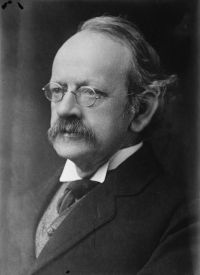
Portrait of Joseph John Thomson Joseph John Thomson Rays of Positive Electricity and Their Application to Chemical Analyses… (1913)

When the tap T is turned the gas has to pass through this capillary: it does so exceedingly slowly. The rate can be adjusted by raising or lowering a mercury reservoir connected with A, this is held in such a position that when the Gaede pump is in action the pressure in the discharge tube is such as to give well developed positive rays. To screen off the magnetic field due to the electromagnet, thick iron plates V,W, Fig. 10, are placed round the neck of the tube.
Source: Wikisource

Portrait of Joseph John Thomson Joseph John Thomson Rays of Positive Electricity and Their Application to Chemical Analyses… (1913)

There is considerable advantage in using very large glass vessels for the discharge tubes when studying positive rays; with large vessels the pressure can be made very small before the tube offers great resistance to the passage of the discharge through It The increase in the difficulty of getting the discharge to pass comes in at the pressure when the dark space round the cathode reaches the walls of the tube. When the tube is big the walls are far away from the cathode and the pressure has to be exceedingly low before the dark space reaches the sides of the tube.
Source: Wikisource

Portrait of Joseph John Thomson Joseph John Thomson Rays of Positive Electricity and Their Application to Chemical Analyses… (1913)

This plan Is convenient because the deflections of the different kinds of positive rays differ so much that it is difficult to measure them accurately when they are all on one plate, For example the magnetic deflection of the hydrogen atoms Is about fourteen times that of the mercury one, thus If the deflection of the hydrogen atom is within the limits of the plate, that of the mercury atom would be too small to measure accurately.
Source: Wikisource

Get perspective with Kwize: daily news enlightened by great literature