Summary

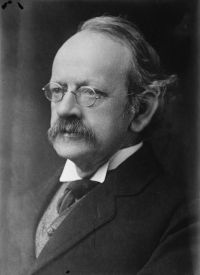
Portrait of Joseph John Thomson Joseph John Thomson 1911 Encyclopædia Britannica, Volume 27… (1911)

The magnitude of the potential fall and the length of the dark space are determined by the condition that the positive particles when they strike against the cathode must give to it sufficient energy to liberate the number of cathode particles which produce, when they ionize the gas, sufficient positive particles to carry this amount of energy. Thus the cathode fall may be regarded as existing to make the cathode emit negative corpuscles. If the cathode can be made to emit corpuscles by other means, the cathode fall of potential is not required and may disappear.
Source: Wikisource

Portrait of Joseph John Thomson Joseph John Thomson 1911 Encyclopædia Britannica, Volume 27… (1911)

A common type of rectifier is another tube containing gas at a low pressure and having one of its electrodes very large and the other very small; a current passes much more easily through such a tube from the small to the large electrode than in the opposite direction. Sometimes an air-break inserted in the circuit with a point for one electrode and a disk for the other is sufficient to prevent the reversal of the current without the aid of any other rectifier.
There are cases, however, when the inevitable intermittence of the discharge produced by an induction coil is a fatal objection.
Source: Wikisource

Portrait of Joseph John Thomson Joseph John Thomson 1911 Encyclopædia Britannica, Volume 27… (1911)

The cathode fall of potential measures the smallest difference of potential which can produce a spark through the gas. Thus, for example, it is not possible to produce a spark through nitrogen with platinum electrodes with a potential difference of less than 232 volts, except when the electrodes are placed so close together that with a smaller potential difference the electric force between the terminals amounts to more than a million volts per centimetre
Source: Wikisource

Get perspective with Kwize: daily news enlightened by great literature