Joseph John Thomson

Joseph John Thomson

Summary

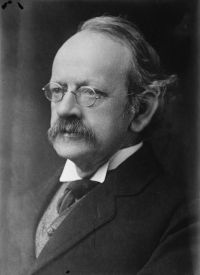
Portrait of Joseph John Thomson Joseph John Thomson,  Cathode Rays (1897)

“ The brightest spots on the glass are by no means always the terminations of the brightest streaks of luminosity in the gas; in fact, in some cases a very bright spot on the glass is not connected with the cathode by any appreciable luminosity, though there may be plenty of luminosity in other parts of the gas. One very interesting point brought out by the photographs is that in a given magnetic field, and with a given mean potential-difference between the terminals, the path of the rays is independent of the nature of the gas. ”
Source: Wikisource

Portrait of Joseph John Thomson Joseph John Thomson,  Cathode Rays (1897)

“ Thus the charge within the inner cylinder does not go on continually increasing; the cylinder settles down into a state of equilibrium in which the rate at which it gains negative electricity from the rays is equal to the rate at which it loses it by conduction through the air. If the inner cylinder has initially a positive charge it rapidly loses that charge and acquires a negative one; while if the initial charge is a negative one, the cylinder will leak if the initial negative potential is numerically greater than the equilibrium value. ”
Source: Wikisource

Portrait of Joseph John Thomson Joseph John Thomson,  Cathode Rays (1897)

“ It might be supposed that the independence of the mass of the carriers of the gas through which the discharge passes was due to the mass concerned being the quasi mass which a charged body possesses in virtue of the electric field set up in its neighbourhood; moving the body involves the production of a varying electric field, and, therefore, of a certain amount of energy which is proportional to the square of the velocity. ”
Source: Wikisource

Get perspective with Kwize: daily news enlightened by great literature