Summary

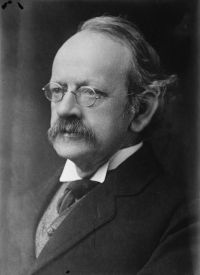
Portrait of Joseph John Thomson Joseph John Thomson Rays of Positive Electricity and Their Application to Chemical Analyses… (1913)

If we regard the forces which keep the atoms together as electrical in their origin, the question naturally arises, are the two atoms in a molecule of hydrogen, for example, charged one with positive the other with negative electricity; or in a molecule of hydrochloric acid gas is the hydrogen atom positively charged, the chlorine negatively, or in a compound like ammonia NH3 does the nitrogen atom carry three negative charges and each of the hydrogen atoms one positive one ?
Source: Wikisource

Portrait of Joseph John Thomson Joseph John Thomson Rays of Positive Electricity and Their Application to Chemical Analyses… (1913)

If the carbon atom in the molecule were positively, the oxygen atom negatively electrified, then we should expect that if a molecule of CO were split into atoms by the impact of a rapidly moving positively electrified particle, there would be a tendency for the carbon atoms to have a positive charge and for the oxygen ones to have a negative, so that in the positive rays we should expect to find more carbon atoms than oxygen ones.
Source: Wikisource

Portrait of Joseph John Thomson Joseph John Thomson Rays of Positive Electricity and Their Application to Chemical Analyses… (1913)

As one parabola after another was passed, positive electricity would come abruptly through the slit, and the amount of the charge would be a measure of the number of particles passing through the slit. If instead of moving the parabolic slit we keep the slit fixed and gradually increase the magnetic field used to deflect the particles, we shall in this way drive one parabola after another on to the slit, beginning with the parabola due to the hydrogen atom and ending with that due to the mercury one, and the charges passing the slits will be proportional to the number of particles.
Source: Wikisource

Get perspective with Kwize: daily news enlightened by great literature