Summary

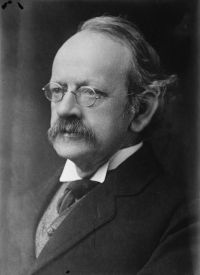
Portrait of Joseph John Thomson Joseph John Thomson Rays of Positive Electricity and Their Application to Chemical Analyses… (1913)

But though cathode rays may produce some charged atoms they more frequently produce charged molecules, the chief source of the charged atoms being positive rays, i.e. rapidly moving charged molecules or atoms. The view that the charged atoms and molecules are produced by different agents helps us to understand the remarkable variations which occur in the relative intensities of the lines due to the atoms and molecules of the same element. To take the case of hydrogen, sometimes the line due to the atom is stronger than that due to the molecule, at others it is weaker.
Source: Wikisource

Portrait of Joseph John Thomson Joseph John Thomson Rays of Positive Electricity and Their Application to Chemical Analyses… (1913)

Judging from the intensity of the lines we should conclude that the number of multiply charged atoms is only a small fraction of the number with one charge. The ratio of the number of atoms which have only one charge to that of those which have two or more charges is very variable and depends on conditions which are not yet fully understood. For example in the case of the carbon atom this ratio seems to depend to a very great extent on the type of gaseous carbon compound in the discharge tube. With some hydrocarbons the doubly charged carbon atoms are relatively much brighter than with others.
Source: Wikisource

Portrait of Joseph John Thomson Joseph John Thomson Rays of Positive Electricity and Their Application to Chemical Analyses… (1913)

We should expect that the cathode particles, since they penetrate into the atom and come Into contact with the corpuscles Individually—the collision in favourable cases resulting In the detachment of a corpuscle—would give rise to singly charged systems, and If they struck a molecule might detach a corpuscle from one of the atoms without separating one atom from another, producing in this way a positively charged molecule.
Source: Wikisource

Get perspective with Kwize: daily news enlightened by great literature