Parabola

Definition and stakes

Charles Everitt, Olaus Henrici, Edwin B. Elliott, John H. Grace, Bertrand A. W. Russell and Alfred N. Whitehead,  1911 Encyclopædia Britannica (1911)

“ The axis which contains the foci is called the principal axis; in case of an hyperbola it is the axis which cuts the curve, because the foci lie within the conic.
In case of the parabola there is but one axis. The involution on this axis has its centre at infinity. One focus is therefore at infinity, the one focus only is finite. A parabola has only one focus.
”
Source: Wikisource

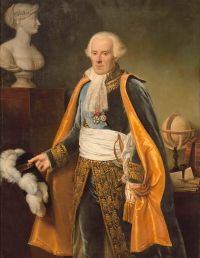
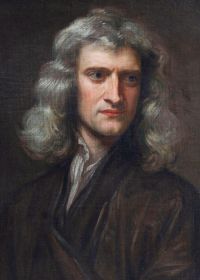
Portrait of Isaac Newton Isaac Newton,  The Mathematical Principles of Natural Philosophy (1846)

“ Cor. Hence the areas of all curves may be nearly found; for if some number of points of the curve to be squared are found, and a parabola be supposed to be drawn through those points, the area of this parabola will be nearly the same with the area of the curvilinear figure proposed to be squared: but the parabola can be always squared geometrically by methods vulgarly known.
LEMMA VI.
Certain observed places of a comet being given, to find the place of the same to any intermediate given time.
”
Source: Wikisource

1911 Encyclopædia Britannica (1911)

“ This is sometimes termed the campaniform (or bell-shaped) parabola. If the two greater roots are equal the equation is (in which a < b) and the curve assumes the form shown in fig. 6, and is known as the nodated parabola. Finally, if all the roots are equal, the equation becomes this curve is the cuspidal or semi-cubical parabola (fig. 7) . This curve, which is sometimes termed the Neilian parabola after William Neil (1637—1670) , is the evolute of the ordinary parabola, and is especially interesting as being the first curve to be rectified. ”
Source: Wikisource

Get perspective with Kwize: daily news enlightened by great literature