Summary

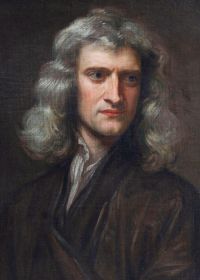
Portrait of Isaac Newton Isaac Newton The Mathematical Principles of Natural Philosophy (1846)

Verifying its truth by the motions of terrestrial bodies, then by those of the moon and other secondary orbs, he finally embraced, in one mighty generalization, the entire Solar System—all the movements of all its bodies—planets, satellites and comets—explaining and harmonizing the many diverse and theretofore inexplicable phenomena.
Guided by the genius of Newton, we see sphere bound to sphere, body to body, particle to particle, atom to mass, the minutest part to the stupendous whole—each to each, each to all, and all to each—in the mysterious bonds of a ceaseless, reciprocal influence.
Source: Wikisource

Portrait of Isaac Newton Isaac Newton The Mathematical Principles of Natural Philosophy (1846)

This most beautiful system of the sun, planets, and comets, could only proceed from the counsel and dominion of an intelligent and powerful Being. And if the fixed stars are the centres of other like systems, these, being formed by the like wise counsel, must be all subject to the dominion of One; especially since the light of the fixed stars is of the same nature with the light of the sun, and from every system light passes into all the other systems:
Source: Wikisource

Portrait of Isaac Newton Isaac Newton The Mathematical Principles of Natural Philosophy (1846)

The Principia, above all, glows with the immortality of a transcendant mind. Marble and brass dissolve and pass away; but the true creations of genius endure, in time and beyond time, forever: high upon the adamant of the indestructible, they send forth afar and near, over the troublous waters of life, a pure, unwavering, quenchless light whereby the myriad myriads of barques, richly laden with reason, intelligence and various faculty, are guided through the night and the storm, by the beetling shore and the hidden rock, the breaker and the shoal, safely into havens calm and secure.
Source: Wikisource

Get perspective with Kwize: daily news enlightened by great literature