Summary

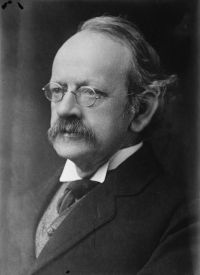
Portrait of Joseph John Thomson Joseph John Thomson Rays of Positive Electricity and Their Application to Chemical Analyses… (1913)

Another effect, which also favours the impurity view, is that the rule of evolution of helium, unlike that of X3 by the bombardment of potash, in nearly every case shows a tendency to diminish after long continued bombardment. This occurs even with salts which have been dissolved and evaporated to dryness. Experiments which are not yet completed are being made to see if the evolution of helium stops entirely after long continued bombardment.
Source: Wikisource

Portrait of Joseph John Thomson Joseph John Thomson Rays of Positive Electricity and Their Application to Chemical Analyses… (1913)

There Is another possibility which It Is much more difficult to eliminate by means of physical experiments, though the chemical properties of the inert gases may be thought to make It very improbable; this is that helium can combine with a large number of elements and that these helium compounds exist as impurities In the salts of these elements and that these compounds of helium, present as impurities in soluble salts, are also soluble.
Source: Wikisource

Portrait of Joseph John Thomson Joseph John Thomson Rays of Positive Electricity and Their Application to Chemical Analyses… (1913)

If we were to take elements of much greater atomic weight the residues would have high atomic weights also and these heavy atoms are not detected by the photographic plate nearly so easily as the lighter ones like helium, so that even if there were the same number of the atoms of the residue as of the helium present In the tube the helium might show on the plate while the residues did not.
Source: Wikisource

Get perspective with Kwize: daily news enlightened by great literature