Summary

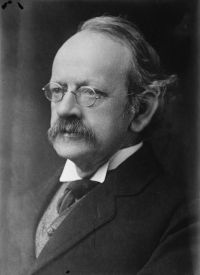
Portrait of Joseph John Thomson Joseph John Thomson Rays of Positive Electricity and Their Application to Chemical Analyses… (1913)

It is easy to understand in a general way why particles with the large amount of energy possessed by the positive rays when they strike against an atom in the cathode might communicate to it sufficient energy to enable it to escape from the cathode. A complete theory, however, is lacking, and one which would explain some of the more striking facts, such as why the value of S is so nearly the same for metals of very different physical and chemical properties, would probably throw a good deal of light upon some important properties of the atom.
Source: Wikisource

Portrait of Joseph John Thomson Joseph John Thomson Rays of Positive Electricity and Their Application to Chemical Analyses… (1913)

Some of the atoms constituting the positive rays seem to enter a metal against which they strike, and either combine with the metal or get absorbed by it. Helium, neon, and mercury vapour seem especially noticeable in this respect. If a cathode has once been used for any of these gases, positive rays corresponding to these elements will be found when the cathode is used with other gases, and it requires long continued discharge and repeated fillings with other gases before they are eliminated.
Source: Wikisource

Portrait of Joseph John Thomson Joseph John Thomson Rays of Positive Electricity and Their Application to Chemical Analyses… (1913)

In addition to the effects produced when the positive rays strike against a metal plate there is, as Schmidt has shown, a general oxidation over the surface when the metal is oxldizable and when the gas surrounding it contains oxygen. The passage of the positive rays through the oxygen produces atomic oxygen which is very active chemically and which attacks the plate.
Source: Wikisource

Get perspective with Kwize: daily news enlightened by great literature