Summary

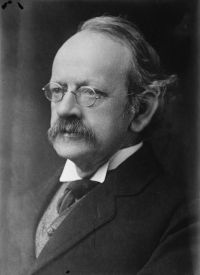
Portrait of Joseph John Thomson Joseph John Thomson Rays of Positive Electricity and Their Application to Chemical Analyses… (1913)

The other case in which I have observed a negatively charged molecule is that of oxygen; the negatively charged oxygen atom produces what in many cases is the strongest line on the negative side: the negatively charged oxygen molecule is only met with in exceptional cases. The causes which determine its appearance have not yet been made out: it probably depends on the presence in the tube of some special type of carbon compound. It does not seem to occur in very carefully purified oxygen, I have found it most frequently in oxygen containing a little hydrogen.
Source: Wikisource

Portrait of Joseph John Thomson Joseph John Thomson Rays of Positive Electricity and Their Application to Chemical Analyses… (1913)

If these freely moving corpuscles are which are near the surface and which give rise to the forces which bind the atoms In the molecule together, we can readily understand why a neutral molecule should not attract a corpuscle as vigorously as a neutral atom. For when two atoms in a molecule are held together by the forces which they exert on each, the corpuscles in each atom will take up definite positions in their atoms, and will resist any displacement. Their mobility will thus be diminished and they will therefore not exert much attraction on a charge of electricity outside them.
Source: Wikisource

Portrait of Joseph John Thomson Joseph John Thomson Rays of Positive Electricity and Their Application to Chemical Analyses… (1913)

To take a definite case, let us suppose that the negatively charged hydrogen atom owes its charge to having been in chemical combination with an atom of carbon before it passed through the cathode, the molecule of the compound being positively charged when in the discharge tube and acquiring a high velocity under the electric field. After passing through the cathode the molecule gets neutralized and then dissociates into a positively charged carbon atom and a negatively charged hydrogen one.
Source: Wikisource

Get perspective with Kwize: daily news enlightened by great literature