Summary

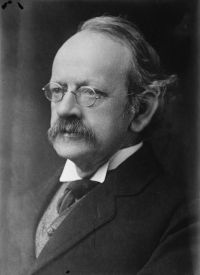
Portrait of Joseph John Thomson Joseph John Thomson 1911 Encyclopædia Britannica, Volume 6… (1911)

Thus any process which a single particle is able to effect by virtue of its energy will be done just as well a thousand miles away from the source of light as at the source itself, though of course in a given space there will not be nearly so many particles to do this process far from the source as there are close in. Thus, if one of the particles when it struck against a piece of metal caused the ejection of a corpuscle with a given velocity, the velocity of emission would not depend on the intensity of the light.
Source: Wikisource

Portrait of Joseph John Thomson Joseph John Thomson 1911 Encyclopædia Britannica, Volume 6… (1911)

If we ionize a mixture of two very different gases, say hydrogen and carbonic acid, and investigate the nature of the ions by measuring their velocities, the question arises, shall we find two kinds of positive and two kinds of negative ions moving with different velocities, as we should do if some of the positive ions were positively charged hydrogen molecules, while others were positively charged molecules of carbonic acid; or shall we find only one velocity for the positive ions and one for the negative?
Source: Wikisource

Portrait of Joseph John Thomson Joseph John Thomson 1911 Encyclopædia Britannica, Volume 6… (1911)

Imagine a corpuscle projected with considerable velocity from a place where the electric field is strong, such as the neighbourhood of the cathode; as it moves towards the anode through the gas it will collide with the molecules, ionize them and lose energy and velocity. Thus unless the corpuscle is acted on by a field strong enough to supply it with the energy it loses by collision, its speed will gradually diminish.
Source: Wikisource

Get perspective with Kwize: daily news enlightened by great literature