Joseph John Thomson

Joseph John Thomson

Summary

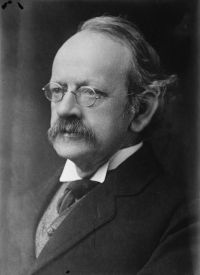
Portrait of Joseph John Thomson Joseph John Thomson 1911 Encyclopædia Britannica (1911)

On the ordinary view of an electric wave all the molecules would be affected by the wave when it passed through a gas, and to explain the small fraction ionized we must either suppose that systems sensitive to the Rontgen rays are at any time present only in a very small fraction of the molecule or else that the front of an electric or light wave is not continuous but that the energy is concentrated in patches which only occupy a fraction of the wave front.
Source: Wikisource

Portrait of Joseph John Thomson Joseph John Thomson 1911 Encyclopædia Britannica (1911)

If the instrument is used to detect waves in air, long straight wires are attached to the ends of the demagnetizing coil to collect the energy from the field; to investigate waves in wires it is sufficient to make a loop or two in the wire and place the magnetized piece of iron inside it. The amount of demagnetization which can be observed by the change in the deflection of a magnetometer placed near the iron, measures the intensity of the electric waves, and very accurate determinations can be made with ease with this apparatus.
Source: Wikisource

Portrait of Joseph John Thomson Joseph John Thomson 1911 Encyclopædia Britannica (1911)

In order to excite the waves, C and D are connected to the two poles of an induction coil; sparks cross the air-gap which becomes a conductor, and the charges on the plates oscillate backwards and forwards like the charges on the coatings of a Leyden jar when it is short-circuited. The object of polishing the balls and screening off light is to get a sudden and sharp discharge; if the balls are rough there will be sharp points from which the charge will gradually leak, and the discharge will not be abrupt enough to start electrical vibrations, as these have an exceedingly short period.
Source: Wikisource

Get perspective with Kwize: daily news enlightened by great literature