Ernest Rutherford

Definition and stakes

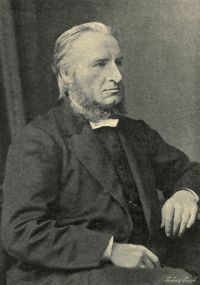
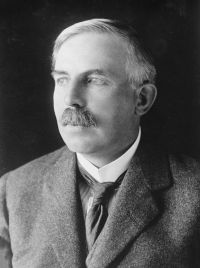
Portrait of Ernest Rutherford Ernest Rutherford,  Radio-Activity

“ The study of the radio-active substances and of the discharge of electricity through gases has supplied very strong experimental evidence in support of the fundamental ideas of the existing atomic theory. It has also indicated that the atom itself is not the smallest unit of matter, but is a complicated structure made up of a number of smaller bodies. ”

Source: Gutenberg

Portrait of Ernest Rutherford Ernest Rutherford,  Radio-Activity

“ The theory supposes that, on an average, a definite small proportion of the atoms of each radio-active substance becomes unstable at a given time. As a result of this instability, the atoms break up. In most cases, the disintegration is explosive in violence and is accompanied by the ejection of an α particle with 446great velocity; in a few cases, α and β particles are expelled together, while in others a β particle alone escapes. In a few cases, the change in the atom appears to be less violent in character, and is not accompanied by the expulsion of either an α or β particle. ”
Source: Gutenberg

Portrait of Ernest Rutherford Ernest Rutherford,  Radio-Activity

“ There thus seems little doubt that a stream of negative particles (electrons) is projected from the active surface at a very slow speed. Such low velocity electrons are also projected from uranium and radium. It is probable that these electrons are 154a type of secondary radiation, set up at the surfaces on which the α rays fall. The particles would be extremely readily absorbed in the gas, and their presence would be difficult to detect except in low vacua. J. J. Thomson at first obtained no evidence that the α particles of polonium were charged ”
Source: Gutenberg

Get perspective with Kwize: daily news enlightened by great literature