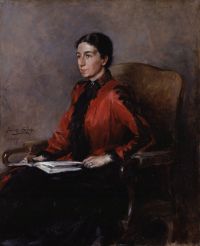
“ He was then in the middle of his Oxford years, and Raeburn's letters and Raeburn's influence had certainly pulled him through various scrapes that might have been disastrous. Then—a little later—he could see the shooting lodge on the moors above Loch Etive, where he and Raeburn, Lord Maxwell, Miss Raeburn, and a small party had spent the August of his twenty-first birthday. Well—that surly keeper, and his pretty wife who had been Miss Raeburn's maid—could anything be more inevitable? A hard and jealous husband, and one of the softest, most sensuous natures that ever idleness made love to. ”
Raeburn
Definition and stakes
The theme of “Raeburn” has been addressed by authors such as Sir J. L. Caw, Edna Lyall, John Miller Gray, Mrs. Humphry Ward and Robert Louis Stevenson. It is often associated with terms like Thomas, Reuben, Erica, Edinburgh and John.
Quotes about “Raeburn”
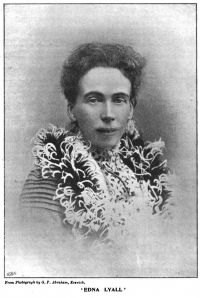
“ Still, as on that November afternoon he watched Raeburn and his daughter down Southampton Row, he was conscious that for the first time he fully regarded the atheist as a fellow-man. The fact was that Raeburn had for long years been the champion of a hated cause; he had braved the full flood of opposition; and like an isolated rock had been the mark for so much of the rage and fury of the elements that people who knew him only by name had really learned to regard him more as a target than as a man. ”
“ It was probably the opening for an artist offered by these altered circumstances which had brought Martin to Edinburgh, and certainly Raeburn was fortunate in that his emergence coincided with them. An attractive and clever lad devoting himself to art in a community increasing in wealth and expanding in ideas, and with a sympathetic master coming in contact with the upper classes, Raeburn could not fail to make acquaintances able and willing to help him. ”
“ Luke Raeburn with his honesty, his great abilities, his gift of reasoning, above all his thorough earnestness, had the best of it. To be beaten in argument was naturally the one thing which such a man as Mr. Raeburn could not forgive. He might in time have learned to tolerate a difference of opinion, he would beyond a doubt have forgiven almost any of the failings that he could understand, would have paid his son's college debts without a murmur, would have overlooked anything connected with what he considered the necessary process of “sowing his wild oats.” ”
“ Be this as it may, the handling, lighting, and tone and disposition of the colour are eminently characteristic of much of the work done by Raeburn about 1790. I If, during the last century, Scotland has shown exceptional activity in the arts, especially in painting, and has produced a succession of artists whose work is marked by able craftsmanship and emotional and subjective qualities, which give it a distinctive place in modern painting, the more than two hundred years which lay between the Reformation and the advent of Raeburn seemed to hold little promise of artistic development. ”
“ No doubt election was particularly gratifying to Raeburn. Isolated as he was in Edinburgh, where an Academy did not come into existence until some years after his death, it must have been stimulating to receive such tangible assurance of that appreciation of one's fellow-workers which is the most grateful form of admiration to the artist. He reciprocated by offering as his diploma work the impressive portrait of himself, which is now one of the treasures of the National Gallery of Scotland. ”
“ Raeburn smiled rather bitterly. “You need not fear that. My reputation has long been at the mercy of all the lying braggarts in the country. Men label me socialist one day, individualist the next. I become communist or egotist, as is most convenient to the speaker and most damaging to myself. But there,” he exclaimed, regaining the tranquil serenity which characterized him, “why should I rail at the world when I might be talking to you? How is my old friend Hans?” The sound of a key in the latch startled them. “It is only Erica,” said Raeburn. ”
“ Formed under these influences, his style possesses no clearly marked national trait, except it be the feeling for character which informs his finer work and makes it, in a way, a link between that of Jamesone and that of Raeburn. To this he added a delicate sense of tone and a tenderness of colour and lighting, a gracefulness of drawing and a refined accomplishment which were new in Scottish painting. ”
“ I never see a man I think equal to my own brothers!' Now, whatever faults Raeburn has, we may be sure Erica sees far less plainly than we see, and nobody can deny that he is a grand fellow. When one bears in mind all that he has had against him, his nobility of character seems to me marvelous. He puts us to shame. And that is why he seems to me the wholesome though powerful medicine for this nineteenth century of ours, with its great professions and its un-Christlike lives. ”
“ In the meantime, Raeburn had spent a miserably anxious evening, regretting his rash permission for Erica to go, regretting his own enforced inaction, regretting his well-known and undisguisable face and form, almost regretting that his friend had visited him. Like Erica, he was only personally brave; he could not be brave for other people. Actual risk he would have enjoyed, but this anxious waiting was to him the keenest torture. ”
“ He had lived and painted solely in Scotland, and Scottish art, like foreign art, so long as it remains at home, has little interest for London, which, sure of its attractive power, sits arrogantly still till art is brought to it. But Raeburn's work possesses that inherent power, which, seen by comprehending eyes, compels admiration. ”
“ He used to declare that the advice of James Byres (1734-1818?) of Tonley, who, in Raeburn's own words, was "a man of great general information, a profound antiquary, and one of the best judges perhaps of everything connected with art in Great Britain," was the most valuable lesson he received while abroad. "Never paint anything except you have it before you" was what his friend urged, and, while Raeburn, to judge from his early portraits, did not stand greatly in need of the injunction, it probably strengthened him in his own beliefs. ”
“ Raeburn went to live at his wife's property, which lay not far from his brother's house and factory at Stockbridge, and, although sitters increased with his growing reputation until he is said to have been quite independent of his wife's income, he does not appear to have had a separate studio. ”
“ Arrived back in Edinburgh in 1787, Raeburn took a studio in the new town, and, with his enhanced powers and the added prestige due to his sojourn abroad, soon occupied a commanding place. Few agreed with Martin that "the lad in George Street painted better before he went to Italy," for if the majority were unaware of his high artistic gifts, none could be unconscious of the vital and convincing quality of his portraitures. His earlier sitters included some of the most distinguished people in Scotland. ”
“ But for the privilege of solitude, Aldous Raeburn would at that moment have faced a good deal more than the two miles of extra walking which now lay between him and Maxwell Court.About him, as he trudged on, lay a beautiful world of English woodland. After he had passed through the hamlet of Mellor, with its three-cornered piece of open common, and its patches of arable—representing the original forest-clearing made centuries ago by the primitive fathers of the village in this corner of the Chiltern uplands—the beech woods closed thickly round him. ”
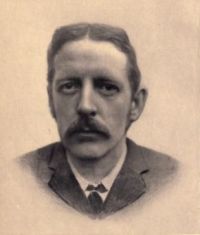 John Miller Gray,
Dictionary of National Biography…
(1893)
John Miller Gray,
Dictionary of National Biography…
(1893)
“ Deeply impressed by the paintings of Raeburn, he began, at the age of about twenty-five, to study as a portrait-painter. His productions gained for him Raeburn's friendship, and he worked in Raeburn's studio. In 1812, when he was residing in Shakespeare Square, he contributed a portrait of a gentleman to the Exhibition of Associated Artists, Edinburgh, and he continued to contribute to the same exhibitions from 1814 to 1816. ”
Thomas Raeburn (1850s)
“ He had as many cats, and fed them as well as any old maid ever did in broad Scotland, and was so well known to the little birds of the air that they would come with fluttering wings at his call, perch on his shoulder, and peck the very crumbs from his Aaronic beard. Some years before his death Raeburn slipped his foot during frosty weather and broke his arm; as he included the sons of Galen in the same category with lawyers, taxmen, and gangers, he would not call a doctor, so that the bone never having reduced secundun artem, his arm was rendered nearly useless. ”
“ For long also it confined the Scottish painter's reputation to his own country. Forty years after his death, his art was so little known in England that the Redgraves, in their admirable history of English painting, relegated him to a chapter headed "The Contemporaries of Lawrence." Time brings its revenges, however, and of late years Raeburn has taken a place in the very front rank of British painters. ”
“ Though not without a strong vein of sarcasm, Raeburn's speech was, on the whole, temperate; it certainly should have been met with consideration. But, unfortunately, Mr. Randolph was incapable of seeing any good in his opponent; his combative instincts were far stronger than his Christianity, and Brian, who had winced many times while listening to the champion of atheism, was even more keenly wounded by the champion of his own cause. Abusive epithets abounded in his retort; at last he left the subject under discussion altogether, and launched into personalities of the most objectionable kind. ”
“ Erica's father was unquestionably a large-souled man, in every sense of the word, a great man; but the best man in the world is to a great extent dependent on circumstance, and the circumstances of Raeburn's life had been exceptionally hard. Only two things on earth acted as a check upon the one great fault which marred an otherwise fine character. Beauty of scenery made him for the time being as humble as a child, and the devotion of his own followers sometimes made him ask himself whether he were worthy of such love. ”
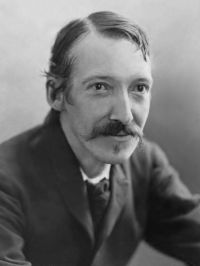 Robert Louis Stevenson,
New Arabian Nights
(1895)
Robert Louis Stevenson,
New Arabian Nights
(1895)
“ Decisive actions are often taken in a moment and without any conscious deliverance from the rational parts of man. So it was now with Mr. Rolles. He glanced hurriedly round; beheld, like Mr. Raeburn before him, nothing but the sunlit flower-garden, the tall tree-tops, and the house with blinded windows; and in a trice he had shut the case, thrust it into his pocket, and was hastening to his study with the speed of guilt. The Reverend Simon Rolles had stolen the Rajah's Diamond. Early in the afternoon the police arrived with Harry Hartley. ”
David Pryde, The Queer Folk of Fife: Tales from the Kingdom
“ The worthy people of Sandyriggs were still discussing this strange catastrophe, when a new surprise claimed their notice. Intelligence came regarding the long-lost Charles Raeburn. His cousin, the doctor, received a letter from him, bearing the postmark of a town in Spain, and empowering him to sell Cowslip Brae and transmit the price. Before the gossips had ceased to puzzle their brains over this extraordinary sacrifice, [Pg 30] another letter arrived and explained the whole mystery. ”
“ Raeburn or his colleagues, try to find all the points we have in common, try as far as possible to meet them on their own ground.” “And the result will be that people will call you an atheist yourself!” broke in Mr. Roberts. “That would not greatly matter,” said Charles Osmond. “It would be a mere sting for the moment. It is not what men call us that we have to consider, but how we are fulfilling the work God has given us to do.” “'Pon my life, it makes me feel sick to hear you talk like this about that miserable Raeburn!” exclaimed Mr. Roberts, hotly. ”
John Miller Gray,
Notes on the Art Treasures at Penicuik House Midlothian
“ There is in this group none of the strong, positive, insufficiently gradated colour, which is sometimes rather distressing in Raeburn’s work. It is far quieter and more delicate than is altogether usual in his art, full of tenderness and subtlety; the faces exquisitely lit by reflected light, their half-shadows softly luminous and delicate exceedingly, never sinking with a crash into blackness and opacity. The artist has seldom produced a finer or more artistic group, has seldom given us a more fascinating portrayal of well-born manhood and of female loveliness. ”
“ Except Runciman, who occasionally varied historical subjects by portraits painted in a broad but somewhat empty manner, and Seaton, an artist of whom little is known but whose rare and seldom seen portraits possess a breadth of handling and a simplicity of design which give the best of them a certain distinction—can they have been an influence with Raeburn?—the Scottish portrait-painters of the eighteenth century were much influenced by Ramsay, and Martin had been his favourite pupil. ”

“ Fullarton might get tired of waiting for you and drive home. The mails will have been given out long ago, and he is probably at Morphie by this time.’ ‘Come now, Miss Raeburn; I am afraid you think me incapable of walking to Fullarton, when, in reality, I should find it a small thing to do for the pleasure of sitting here with you. Confess it: you imagine me a poor sort of fellow—one who, through the custom of being well served, can do little for himself. ”
“ No one talked less scandal, no one put the uglinesses of life away from her with a hastier hand than Lady Winterbourne. She was one of the most consistent of moral epicures."Yes, extremely disagreeable," said Miss Raeburn, sitting bolt upright. "The man has no principles—never had any, since he was a child in petticoats. I know Aldous thinks him unscrupulous in politics and everything else. ”
Robert Louis Stevenson,
Weir of Hermiston
(1896)
“ The character of the hero, Weir of Hermiston, is avowedly suggested by the historical personality of Robert Macqueen, Lord Braxfield. This famous judge has been for generations the subject of a hundred Edinburgh tales and anecdotes. Readers of Stevenson's essay on the Raeburn exhibition, in Virginibus Puerisque, will remember how he is fascinated by Raeburn's portrait of Braxfield, even as Lockhart had been fascinated by a different portrait of the same worthy sixty years before (see Peter's Letters to His Kinsfolk) ; nor did his interest in the character diminish in later life. ”
1911 Encyclopædia Britannica, Volume 12… (1911)
“ His natural taste for art quickly developed itself, and his father was persuaded to allow him to adopt it as his profession. Captain Watson was himself a skilful draughtsman, and his brother George Watson, afterwards president of the Scottish Academy, stood high as a portrait painter, second only to Sir Henry Raeburn, who also was a friend of the family. ”
Thomas Raeburn (1850s)
“ The law was surely very remiss here; we have seen men again and again hanged in Glasgow for crimes not one-tenth so had as Raeburn’s case; and yet for all this some of his biographers seem to chuckle over the unfortunate man’s misfortunes as a piece of merriment. The poor fellow seemed to feel gratefully when any of his visitors sympathised with him in his mishaps; and is there anything to be amazed at in this? Human nature, to a certain degree, operates in like manner in every breast, and he who has no sympathy for misfortune unmerited, is unworthy the name of man. ”
“ Gavin Hamilton (1723-98) and Jacob More (1740?-93) two of its most conspicuous pictorial exponents were Scots by birth, but they had lived so long abroad that Scotland had become to them little more than a memory. The work of the former was in many ways an embodiment of the current dilettante conception of art, and kindred in kind, though earlier in date, to that of Jacques Louis David (1748-1825) under whose sway, towards the close of the century, classic ideals came to dominate the art of Europe outside these isles. His usefulness to Raeburn was chiefly that of a cicerone. ”

