Atomic nucleus

Definition and stakes

Various,  Popular Science Monthly (1915)

“ From the point of view of the nucleus theory, the atomic weight of an element, while in some cases approximately proportional to its atomic number, is in reality a complicated function of the actual structure of the nucleus. The question why the atomic mass should not necessarily be proportional to the atomic number has already been discussed. While the main properties of an atom are controlled by its nuclear charge, the property of gravitation and also that of radioactivity are to be ascribed mainly, if not entirely, to the nucleus. ”
Source: Wikisource

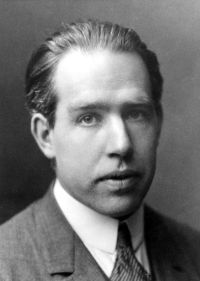
Portrait of Niels Bohr Niels Bohr,  The Theory of Spectra and Atomic Constitution…

“ The conception of atomic structure which will form the basis of all the following remarks is the so-called nuclear atom according to which an atom is assumed to consist of a nucleus surrounded by a number of electrons whose distances from one another and from the nucleus are very large compared to the dimensions of the particles themselves. The nucleus possesses almost the entire mass of the atom and has a positive charge of such a magnitude that the number of electrons in a neutral atom is equal to the number of the element in the periodic system, the so-called atomic number. ”
Source: Gutenberg

Portrait of Alfred North Whitehead Alfred North Whitehead,  Science and the modern world (1925)

“ We can imagine the atomic nucleus as composed of a large number of primates of differing species, and perhaps with many primates of the same species, the whole association being such as to favour stability. An example of such an association is afforded by the association of a positive nucleus with negative electrons to obtain a neutral atom. ”
Source: Gutenberg

Get perspective with Kwize: daily news enlightened by great literature