Summary

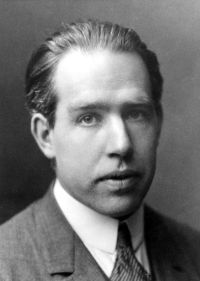
Portrait of Niels Bohr Niels Bohr The Theory of Spectra and Atomic Constitution…

Let us now assume that a hydrogen atom simply consists of an electron revolving around a nucleus of equal and opposite charge, and of a mass which is very large in comparison with that of the electron. It is evident that this assumption may explain the peculiar position already referred to which hydrogen occupies among the elements, but it appears at the outset completely hopeless to attempt to explain anything at all of the special properties of hydrogen, still less its line spectrum, on the basis of considerations relating to such a simple system.
Source: Gutenberg

Portrait of Niels Bohr Niels Bohr The Theory of Spectra and Atomic Constitution…

If we now consider an element whose atoms in the gaseous state do not combine into molecules, it will be necessary to assume that under ordinary conditions nearly all the atoms exist in that stationary state in which the value of the energy is a minimum. This state I shall call the normal state. We must therefore expect that the absorption spectrum of a monatomic gas will contain only those lines of the series spectrum, whose emission corresponds to transitions to the normal state. This expectation is completely confirmed by the spectra of the alkali metals.
Source: Gutenberg

Portrait of Niels Bohr Niels Bohr The Theory of Spectra and Atomic Constitution…

We shall commence by considering the simplest atom conceivable, namely, an atom consisting of a nucleus and one electron. If the charge on the nucleus corresponds to that of a single electron and the system consequently is neutral we have a hydrogen atom. Those developments of the quantum theory which have made possible its application to atomic structure started with the interpretation of the well-known simple spectrum emitted by hydrogen. This spectrum consists of a series of lines, the frequencies of which are given by the extremely simple Balmer formula where and are integers.
Source: Gutenberg

Get perspective with Kwize: daily news enlightened by great literature