Summary

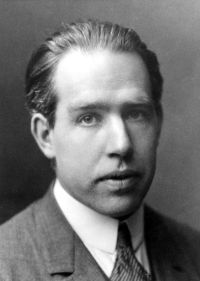
Portrait of Niels Bohr Niels Bohr The effect of electric and magnetic fields on spectral lines (1914)

Let us first consider the effect of an electric field on the hydrogen spectrum. In order to find the effect of the field on the energy of the atom in the different stationary states, we shall seek for its influence on the relation between the energy and the frequency of the system. In this calculation we shall make use of the ordinary mechanics, from analogy with the considerations of the former section.
For simplicity, let us suppose that the mass of the nucleus is infinitely great in comparison with that of the electron.
Source: Gutenberg

Portrait of Niels Bohr Niels Bohr The effect of electric and magnetic fields on spectral lines (1914)

If the field increases, the distances between the sub-components at first increase regularly with the strength of the field. When, however, the distances are of the same order of magnitude as the distance between the components of the original double line, the aspect of the system of lines gradually [Pg 18] alters. The single lines get diffuse and grow together; and when the field is increased still more the whole system of lines tends to shrink into three homogeneous components, with the same relative positions as the components of a simple Zeeman triplet.
Source: Gutenberg

Get perspective with Kwize: daily news enlightened by great literature