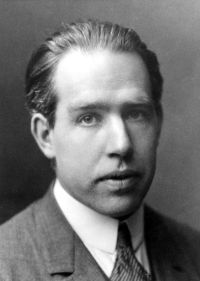
 Niels Bohr,
On the Constitution of Atoms and Molecules
(1913)
Niels Bohr,
On the Constitution of Atoms and Molecules
(1913)
“ Let us now suppose that the system of electrons rotating in a ring round a nucleus is formed in a way analogous to the one assumed for a single electron rotating round a nucleus. It will thus be assumed that the electrons, before the binding by the nucleus, were at a great distance apart from the latter and possessed no sensible velocities, and also that during the binding a homogeneous radiation is emitted. As in the case of a single electron, we have here that the total amount of energy emitted during the formation of the system is equal to the final kinetic energy of the electrons. ”
