Summary

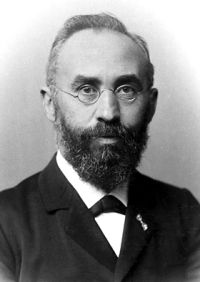
Portrait of Hendrik Lorentz Hendrik Lorentz The theory of electrons and the propagation of light

I do beg of you, however, not to lose sight of the fact that many other physicists, not all of whom I can name in this short space of time, have arrived at the same or very similar conclusions.
The theory of which I am going to give an account represents the physical world as consisting of three separate things, composed of three types of building material: first ordinary tangible or ponderable matter, second electrons, and third ether. I shall have very little to say about ponderable matter, but so much the more about ether and electrons.
Source: Wikisource

Portrait of Hendrik Lorentz Hendrik Lorentz The theory of electrons and the propagation of light

Rather are we constrained to take the view that each individual molecule is permeable. The simplest thing is to suggest further that the same is true of each atom, and this leads us to the idea that an atom is in the last resort some sort of local modification of the omnipresent ether, a modification which can shift from place to place without the medium itself altering its position. Having reached this point, we can consider the ether as a substance of a completely distinctive nature, completely different from all ponderable matter.
Source: Wikisource

Portrait of Hendrik Lorentz Hendrik Lorentz The theory of electrons and the propagation of light

Thanks to the investigations of Van der Waals and other physicists, we know fairly accurately how great a part of the space occupied by a body is in fact filled by its molecules. In fairly dense substances this fraction is so large that we have difficulty in imagining the earth to be of such loose molecular structure that the ether can flow almost completely freely through the spaces between the molecules.
Source: Wikisource

Get perspective with Kwize: daily news enlightened by great literature