Summary

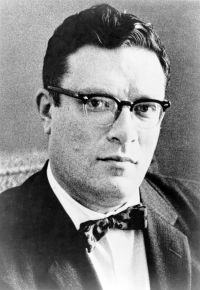
Portrait of Isaac Asimov Isaac Asimov Worlds Within Worlds: The Story of Nuclear Energy…

In the last 200 years, people have seen the coming of the steam engine, the steamboat, the railroad locomotive, the automobile, the airplane, radio, motion pictures, television, the machine age in general. Yet none of it seemed quite so fantastic, quite so unbelievable, as what man has done since 1939 with the atom ... there seem to be almost no limits to what may lie ahead: inexhaustible energy, new worlds, ever-widening knowledge of the physical universe.
Source: Gutenberg

Portrait of Isaac Asimov Isaac Asimov Worlds Within Worlds: The Story of Nuclear Energy…

If the nucleus struck by the neutron is many times as massive as the neutron, the neutron bounced off with all its speed practically intact. On the other hand, if the neutron hits a nucleus not very much more massive than itself, the nucleus rebounds and absorbs some of the energy, so that the neutron bounces away with less energy than it had. If the neutron rebounds from a number of comparatively light nuclei, it eventually loses virtually all its energy and finally moves about quite slowly, possessing no more energy than the atoms that surround it.
Source: Gutenberg

Portrait of Isaac Asimov Isaac Asimov Worlds Within Worlds: The Story of Nuclear Energy…

Of course, protons obtained by the ionization of hydrogen atoms have very little energy, but could energy be imparted to them? Protons carry a positive charge and a force can therefore be exerted upon them by an electric or magnetic field. In a device that makes use of such fields, protons can be accelerated (made to go faster and faster) , and thus gain more and more energy. In the end, if enough energy is gained, the proton could do more damage than the alpha particle, despite the former’s smaller mass.
Source: Gutenberg

Get perspective with Kwize: daily news enlightened by great literature