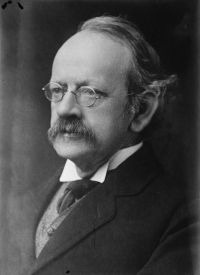
J. J. Thomson

Biographical details

Portrait of J. J. Thomson J. J. Thomson,  Romanes Lecture: The Atomic Theory (1914)

“ For two thousand years the Atomic Theory itself made no progress, because, though in form a physical theory, it had no real connexion with physical phenomena, no facts were known by which it could be tested, and it was too vague to suggest for itself effects which could be put to the test of experiment. It was sterile because it was divorced from experience. It affords a striking proof that a theory can only grow by the co-operation of thought and facts, and that all that is valuable in a physical theory is not only tested, but in most cases suggested, by the study of physical phenomena. ”
Source: Wikisource

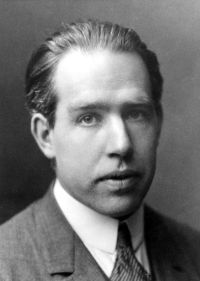
Portrait of J. J. Thomson J. J. Thomson,  Romanes Lecture: The Atomic Theory (1914)

“ These particles are called electrons or corpuscles, and no matter what the nature of the gas may be, whether it is hydrogen, helium, or mercury vapour, the electrons or corpuscles remain unchanged in quality; in fact, there is only one kind of electron, and we can get it out of every kind of matter. The conclusion is irresistible that the electron or corpuscle is a constituent of every atom, and that we are able, by forces which we have even now at our command, to detach it from the atom. ”
Source: Wikisource

Portrait of J. J. Thomson J. J. Thomson,  Romanes Lecture: The Atomic Theory (1914)

“ Lastly, we know that there are regions in the atom, probably the most interesting of all, about which we know little or nothing, whose investigation will provide intensely interesting work for many generations of physicists, who will most assuredly have no reason to be 'mournful that no new wonder may betide'. No fact discovered about the atom can be trivial, nor fail to accelerate the progress of physical science, for the greater part of natural philosophy is the outcome of the structure and mechanism of the atom. ”
Source: Wikisource

Get perspective with Kwize: daily news enlightened by great literature