Condenser

Definition and stakes

Sir J. A. Fleming,  Waves and ripples in water, air… (1912)

“ We may here remark that any arrangement of two metallic plates with a sheet of insulator or non-conductor between them is called a condenser. Thus, a condenser can be built up by coating a sheeting of glass on its two sides with tinfoil, or in place of glass we may use mica, paraffin paper, or any other good non-conductor. We may even use air at ordinary pressures; and thus, if two metal plates are placed near to one another in air, the plates being both insulated—that is, supported on non-conductors,—this arrangement constitutes what is called an air condenser. ”
Source: Gutenberg

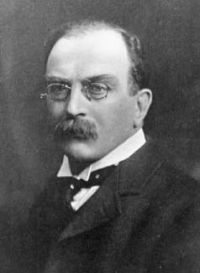
Portrait of Joseph Larmor Joseph Larmor,  1911 Encyclopædia Britannica (1911)

“ Suppose there were accessible an auxiliary system containing an unlimited quantity of heat at absolute temperature T0, forming a condenser into which heat can be discharged from the working system, or from which it may be recovered at that temperature: we proceed to find how much of the heat of our system is available for transformation into mechanical work, in a process which reduces the whole system to the temperature of this condenser. ”
Source: Wikisource

1911 Encyclopædia Britannica, Volume 6… (1911)

“ In woollen manufactures, “condensation” of the wool is an important operation and is accomplished by means of a “condenser.” The term is also given—generally as a qualification, e.g. condensing-syringe, condensing-pump,—to apparatus by which air or a vapour may be compressed. In optics a “condenser” is a lens, or system of lenses, which serves to concentrate or bring the luminous rays to a focus ”
Source: Wikisource

Get perspective with Kwize: daily news enlightened by great literature