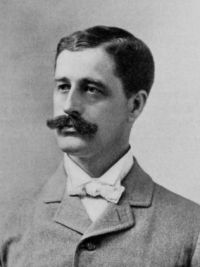
Thomas M. St. John

Biographical details

Thomas M. St. John The Study of Elementary Electricity and Magnetism by Experiment

Can we conduct from one place to another this peculiar state of things, this queer form of potential energy which we call electrification? It is clear, from the last experiments, that in order to do it we need something besides ebonite, which really acts like a closed stop-cock to the flow of electrification.
To keep electrification in one place we need an insulator; to get it from one place to another we need a conductor. Insulators are as important as conductors.
Source: Gutenberg

Thomas M. St. John How Two Boys Made Their Own Electrical Apparatus

When you think of an outfit retailing for 50c. and covering the whole subject of "Static Electricity," giving 60 scientific experiments upon its production, conduction and induction, with a 55–page book of instructions with 38 drawings, and a complete set of apparatus of 20 articles for performing these 60 experiments, you will understand why the sales of this outfit have been enormous. As the subject is presented in a fascinating way—and not as mere dry science—every one likes to do the experiments.
Source: Gutenberg

Thomas M. St. John The Study of Elementary Electricity and Magnetism by Experiment

Can a current of electricity in a conductor induce a current in another conductor not in any way connected with the first? Can current electricity produce effects through space? Is there an electromagnetic induction?
It has been seen that a current-carrying wire has a magnetic field, and that magnetic fields can act through space. It is evident, then, that a conductor will be surrounded and cut by lines of force when it is placed in a magnetic field, or near a wire or coil through which a current passes.
Source: Gutenberg

Get perspective with Kwize: daily news enlightened by great literature