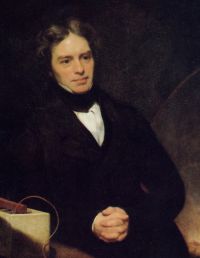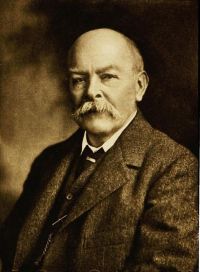
John Henry Poynting

Biographical details

Portrait of John Henry Poynting John Henry Poynting 1911 Encyclopædia Britannica (1911)

The law of gravitation is unique among the laws of nature, not only in its wide generality, taking the whole universe in its scope, but in the fact that, so far as yet known, it is absolutely unmodified by any condition or cause whatever. All other forms of action between masses of matter, vary with circumstances. The mutual action of electrified bodies, for example, is affected by their relative or absolute motion. But no conditions to which matter has ever been subjected, or under which it has ever been observed, have been found to influence its gravitation in the slightest degree.
Source: Wikisource

Portrait of John Henry Poynting John Henry Poynting 1911 Encyclopædia Britannica (1911)

A mere noise is an irregular disturbance. If we study the source producing it we find that there is no regularity of vibration. A musical note always arises from a source which has some regularity of vibration, and which sends equally-spaced waves into the air. A given note has always the same frequency, that is to say, the hearer receives the same number of waves per second whatever the source by which the note is produced. Various instruments have been devised which produce any desired note, and which are provided with methods of counting the frequency of vibration.
Source: Wikisource

Portrait of John Henry Poynting John Henry Poynting On the Transfer of Energy in the Electromagnetic Field (1884)

I have therefore given several cases in considerable detail of the application of the mode of transfer of energy in current-bearing circuits according to the law given above, as I think it is necessary that we should realise thoroughly that if we accept Maxwell's theory of energy residing in the medium, we must no longer consider a current as something conveying energy along the conductor. A current in a conductor is rather to be regarded as consisting essentially of a convergence of electric and magnetic energy from the medium upon the conductor and its transformation there into other forms.
Source: Wikisource

Get perspective with Kwize: daily news enlightened by great literature