Summary

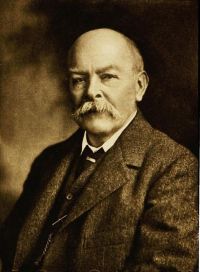
Portrait of John Henry Poynting John Henry Poynting On the Transfer of Energy in the Electromagnetic Field (1884)

When we learn that the "displacement" in a conductor having a current in it increases continually with the time, it is almost impossible to avoid picturing something moving along the conductor, and it then seems only natural to endow this something with energy-carrying power. Of course it may turn out that there is an actual displacement along the lines of electromotive intensity.
Source: Wikisource

Portrait of John Henry Poynting John Henry Poynting On the Transfer of Energy in the Electromagnetic Field (1884)

If we believe in the continuity of the motion of energy, that is, if we believe that when it disappears at one point and reappears at another it must have passed through the intervening space, we are forced to conclude that the surrounding medium contains at least a part of the energy, and that it is capable of transferring it from point to point.
Source: Wikisource

Portrait of John Henry Poynting John Henry Poynting On the Transfer of Energy in the Electromagnetic Field (1884)

I have therefore given several cases in considerable detail of the application of the mode of transfer of energy in current-bearing circuits according to the law given above, as I think it is necessary that we should realise thoroughly that if we accept Maxwell's theory of energy residing in the medium, we must no longer consider a current as something conveying energy along the conductor. A current in a conductor is rather to be regarded as consisting essentially of a convergence of electric and magnetic energy from the medium upon the conductor and its transformation there into other forms.
Source: Wikisource

Get perspective with Kwize: daily news enlightened by great literature