Summary

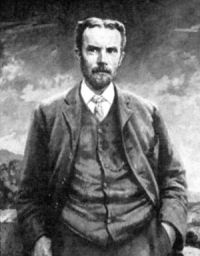
Portrait of Oliver Heaviside Oliver Heaviside Electromagnetic waves, the propagation of potential… (1894)

Taking the second point first, it is, I think, clear that if by the propagation of vector-potential is to be understood that of electric and magnetic disturbances, it is merely the mode of expression that is in question. I am myself accustomed to mentally picture the electric and magnetic forces or fluxes, and their propagation, which takes place at the speed of light or thereabouts, because they give the most direct representation of the state of the medium, which, I think, must be agreed is the real physical subject of propagation.
Source: Wikisource

Portrait of Oliver Heaviside Oliver Heaviside Electromagnetic waves, the propagation of potential… (1894)

As the distribution of displacement varies, its time-variation is the electric current, with determinable magnetic force to match. When the speed of motion is a small fraction of that of light, we may regard the displacement as having at every moment its proper steady distribution, so that there is no difficulty in estimating the magnetic effects, except, it may be, of a merely mathematical character.
Source: Wikisource

Portrait of Oliver Heaviside Oliver Heaviside Electromagnetic waves, the propagation of potential… (1894)

If we terminate the field described in (A) and (B) on a spherical surface of radius a, instead of continuing it up to the charge q at the origin, we have the case of a perfectly conducting sphere of radius a possessing a total charge q, moving steadily at speed u through the dielectric ether. As the speed is increased to v, the charge all accumulates at the equator of the sphere. [See footnote on p. 514, later.]
But after that? This brings us to the third case of u>v, and here I have so-far failed to find any solution which will satisfy all the necessary conditions without unreality.
Source: Wikisource

Get perspective with Kwize: daily news enlightened by great literature