Summary

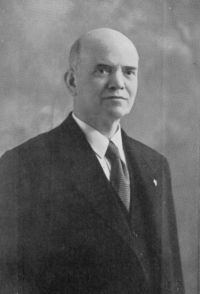
Portrait of Quirino Majorana Quirino Majorana Experimental Demonstration of the Constancy of Velocity of the Light emitted by a Moving Source (1919)

Now in the attaining of a peripheral velocity of nearly 100 m. per second, this being the necessary velocity for a sure appreciation of a displacement in the fringes, two principal mechanical difficulties are found: the enormous centrifugal force, and the very great resistance of air. To diminish the first, it is convenient to enlarge as much as possible the diameter of the trajectory and lessen the number per second of the revolutions. It is known that the centrifugal velocity increases as the square of that number, and the velocity of displacement grows as the first power.
Source: Wikisource

Portrait of Quirino Majorana Quirino Majorana Experimental Demonstration of the Constancy of Velocity of the Light emitted by a Moving Source (1919)

Admitting the second postulate of the theory of relativity, or if, in any way, the velocity of propagation of light by earthly sources seems to us unchangeable, supposing such an apparatus were realized, a certain number f of fringes would be seen to cross the wire of the eyepiece, when the source passes from rest to velocity v,
where l is the difference of path of the interfering rays, λ the length of the wave, and c the velocity of light.
Source: Wikisource

Portrait of Quirino Majorana Quirino Majorana Experimental Demonstration of the Constancy of Velocity of the Light emitted by a Moving Source (1919)

In fact, two experimental circumstances must not be forgotten: first, the presence of materials which are traversed by the interfering rays (air, glass, metals) ; and second, the gravitation field of our earth. While it is possible to imagine experiments entirely apart from the former, it cannot be foreseen if later experimental results will bring into evidence the eventual influence of the second.
Source: Wikisource

Get perspective with Kwize: daily news enlightened by great literature