Summary

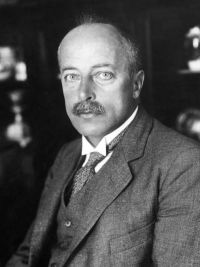
Portrait of Max von Laue Max von Laue Is the Michelson Experiment Conclusive…

A central fringe is black; on either side are coloured fringes, less and less distinct till they fade away into uniform illumination. If the path of either ray is shortened, the fringes move rapidly to one side. If we engrave a scale on I or II, we can, after any alteration of one of the paths, restore with great accuracy and ease the former relations by bringing the central dark fringe to its original place on this scale." Furthermore: "A telescope magnifying thirty-five diameters gave distinct vision of mirror 8, at whose surface the interference-fringes are apparently localized."
Source: Wikisource

Portrait of Max von Laue Max von Laue Is the Michelson Experiment Conclusive…

Then in the air-wedge between and , interference fringes occur that are complementary to the Newtonian fringes of equal thickness. They are located in that plane, in which the telescope objective is projecting the wedge, and they are lines parallel to the edge of the wedge. If is chosen as equal to , then intersects mirror . Then we have a fringe of rate-difference zero in the middle of the visual field, thus a minimum of intensity being the only one that is not displaced when changing the wave length, and remains clear and colorless under illumination by white light.
Source: Wikisource

Get perspective with Kwize: daily news enlightened by great literature