Summary

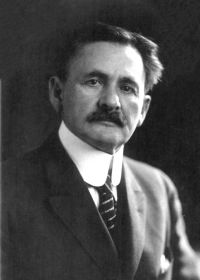
Portrait of Albert Abraham Michelson Albert Abraham Michelson Interference Phenomena in a new form of Refractometer (1882)

The problem of interference in thin films has been studied by Feussner, but his equations do not appear to give the explanation of the phenomena observed. In particular, in the "Annalen der Physik und Chemie," No. 12, 1881, on page 558, Feussner draws the conclusion that the interference fringes are straight lines, whereas, in the above described apparatus they are in general curves: and there is but one case—that of the central fringe in white light—which is straight.
Source: Wikisource

Portrait of Albert Abraham Michelson Albert Abraham Michelson Interference Phenomena in a new form of Refractometer (1882)

If the thickness of the film is zero, or if the angle of incidence is zero, the fringes are formed at the surface of the mirrors. If the film is of uniform thickness, the fringes appear at infinity. If at the same time , and , or and , the position of the fringes is indeterminate. If has the same sign as , the fringes appear in front of the mirrors; if has the opposite sign, the fringes appear behind the mirrors.
Source: Wikisource

Portrait of Albert Abraham Michelson Albert Abraham Michelson Interference Phenomena in a new form of Refractometer (1882)

Consider now a pair of points . Let be the angle formed by the line joining and (or ) with the normal to the surface; and being both supposed small,
.
The difference between this value of and the true value is , where is the angle subtended by at . If is a small quantity, is a small quantity of the second order, and is a small quantity of the fourth order; consequently may be neglected. We have therefore, to a very close approximation, ; or, substituting for , being the distance between the images, at the point where they are cut by the line ,
Let , , fig.
Source: Wikisource

Get perspective with Kwize: daily news enlightened by great literature