Summary

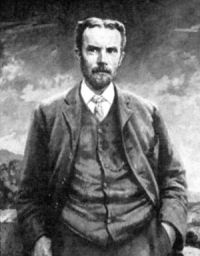
Portrait of Oliver Heaviside Oliver Heaviside On the Electromagnetic Effects due to the Motion of Electrification through a Dielectric (1894)

But in some cases of rotating electrification, there need be no displacement anywhere, except during the setting up of the final state. This brings us to the rather curious question whether there is any difference between the magnetic field of a convection-current produced by the rotation of electrification upon a good nonconductor and upon a good conductor respectively, other than that due to diffusion in the conductor. For in the case of a perfect conductor, it is easy to imagine that the electrification could be at rest, and the moved conductor merely slip past it.
Source: Wikisource

Portrait of Oliver Heaviside Oliver Heaviside On the Electromagnetic Effects due to the Motion of Electrification through a Dielectric (1894)

But should the speed of the moving charge be only a very small fraction of that of the propagation of disturbances, or that of light, it is clear that the accommodation of the displacement to the new positions which are assumed by the charge during its motion is practically instantaneous in its neighbourhood, so that we may imagine the charge to carry about its stationary field of force rigidly attached to it.
Source: Wikisource

Portrait of Oliver Heaviside Oliver Heaviside On the Electromagnetic Effects due to the Motion of Electrification through a Dielectric (1894)

But if perfectly conducting surfaces be given on which to terminate the displacement, the natural motion of the wave will itself carry the electrification along them. In fact we now have the rudimentary telegraph-circuit, with no allowance made for absorption of energy in the wires, and the consequent distortion. If the conductors be not coaxial, we only alter the distribution of the displacement and induction, without affecting the propagation without distortion.
Source: Wikisource

Get perspective with Kwize: daily news enlightened by great literature