Summary

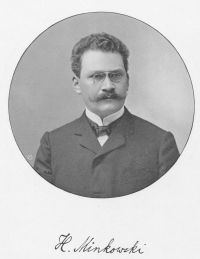
Portrait of Hermann Minkowski Hermann Minkowski Translation:The Fundamental Equations for Electromagnetic Processes in Moving Bodies (1920)

If we take the principal result of the Lorentz transformation together with the fact that the system (A) as well as the system (B) is covariant with respect to a rotation of the coordinate-system round the null point, we obtain the general relativity theorem. In order to make the facts easily comprehensible, it may be more convenient to define a series of expressions, for the purpose of expressing the ideas in a concise form, while on the other hand I shall adhere to the practice of using complex magnitudes, in order to render certain symmetries quite evident.
Source: Wikisource

Portrait of Hermann Minkowski Hermann Minkowski Translation:The Fundamental Equations for Electromagnetic Processes in Moving Bodies (1920)

Now if hereafter, we succeed in maintaining this covariance as a definite connection between pure and simple observable phenomena in moving bodies, the definite connection may be styled the Principle of Relativity.
These differentiations seem to me to be useful for enabling us to characterise the present day position of the electro-dynamics for moving bodies.
H. A. Lorentz has found out the Relativity theorem and has created the Relativity postulate as a hypothesis that electrons and matter suffer contractions in consequence of their motion according to a certain law.
Source: Wikisource

Portrait of Hermann Minkowski Hermann Minkowski Translation:The Fundamental Equations for Electromagnetic Processes in Moving Bodies (1920)

If four space-points, which do not lie in one plane are conceived to be at the same time to, then it is no longer permissible to make a change of the time parameter by a Lorentz-transformation, without at the same time destroying the character of the simultaneity of these four space points.
Source: Wikisource

Get perspective with Kwize: daily news enlightened by great literature