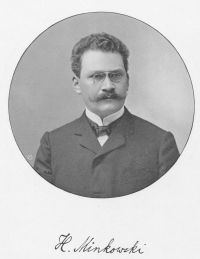
Hermann Minkowski

Hermann Minkowski

Summary

Portrait of Hermann Minkowski Hermann Minkowski,  Space and Time

“ No one has observed a place except at a particular time, or has observed a time except at a particular place. Yet I still respect the dogma that time and space have independent existences each. I will call a space-point at a time-point, i.e., a system of values x, y, z, t, as a world-point. The manifold of all possible value systems of x, y, z, t, shall be denoted as the world. I boldly could draw four world-axes with a chalk upon a table. Even one axis drawn consists of nothing but quickly vibrating molecules, and besides, takes part in all the journeys of the earth in the universe ”
Source: Wikisource

Portrait of Hermann Minkowski Hermann Minkowski,  Space and Time

“ According to this, we shall have, not one space, but an infinite number of spaces in the world, — analogous to the case that the three-dimensional space consists of an infinite number of planes. The three-dimensional geometry becomes a chapter of four-dimensional physics. Now you perceive, why I said in the beginning that time and space shall reduce to mere shadows and we shall have only one world itself. ”
Source: Wikisource

Portrait of Hermann Minkowski Hermann Minkowski,  Space and Time (1920)

“ The greater abstraction required for the four-axes does not cause the mathematician any trouble. In order not to allow any yawning gap to exist, we shall suppose that at every place and time, something perceptible exists. In order not to specify either matter or electricity, we shall simply style these as substances. We direct our attention to the world-point x, y, z, t, and suppose that we are in a position to recognise this substantial point at any subsequent time. ”
Source: Wikisource

Get perspective with Kwize: daily news enlightened by great literature