Summary

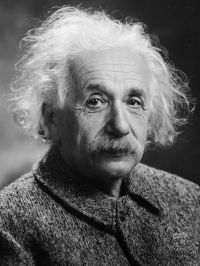
Portrait of Albert Einstein Albert Einstein The Foundation of the Generalised Theory of Relativity (1916)

The Mathematical auxiliaries developed under B at once enables us to generalise, according to the generalised theory of relativity, the physical laws of matter (Hydrodynamics, Maxwell's Electro-dynamics) as they lie already formulated according to the special-relativity-theory. The generalised Relativity Principle leads us to no further limitation of possibilities; but it enables us to know exactly the influence of gravitation on all processes without the introduction of any new hypothesis.
Source: Wikisource

Portrait of Albert Einstein Albert Einstein The Foundation of the Generalised Theory of Relativity (1916)

The laws of physics must be so constituted that they should remain valid for any system of co-ordinates moving in any manner. We thus arrive at an extension of the relativity postulate.
Besides this momentous epistemological argument, there is also a well-known physical fact which speaks in favour of an extension of the relativity theory. Let there be a Galiliean co-ordinate system K relative to which (at least in the four-dimensional region considered) a mass at a sufficient distance from other masses move uniformly in a line.
Source: Wikisource

Portrait of Albert Einstein Albert Einstein The Foundation of the Generalised Theory of Relativity (1916)

The special relativity theory has led to the conception that the inertial mass is no other than energy. It can also be fully expressed mathematically by a symmetrical tensor of the second rank, the energy-tensor. We have therefore to introduce in our generalised theory an energy-tensor associated with matter, which like the energy components of the gravitation-field (equations 49, and 50) have a mixed character but which however can be connected with symmetrical covariant tensors.
Source: Wikisource

Get perspective with Kwize: daily news enlightened by great literature